
Governor Approved NYC’s $200m Backdoor Raid on MTA Bus Funding
Watchdog group Reinvent Albany has documented a backdoor $200 million budget raid on MTA Bus funding. The MTA is expected to discuss its out-year deficits at the November 18, 2026 Board meeting, when its updated November Financial Plan is released.
As part of the state budget passed in late May 2026 (FY26-27), the state allowed New York City a one-time $200 million reduction in annual operating support for MTA Bus. Most observers, including Reinvent Albany, believed the State would fill the funding gap using its massive $87.3 billion cash hoard. Unfortunately, the State has quietly chosen not to compensate MTA Bus, leaving the MTA – and ultimately bus riders – to eat the loss of City funding. (Note: we use the word “raid” to describe the diversion of funds legally dedicated to the MTA.)
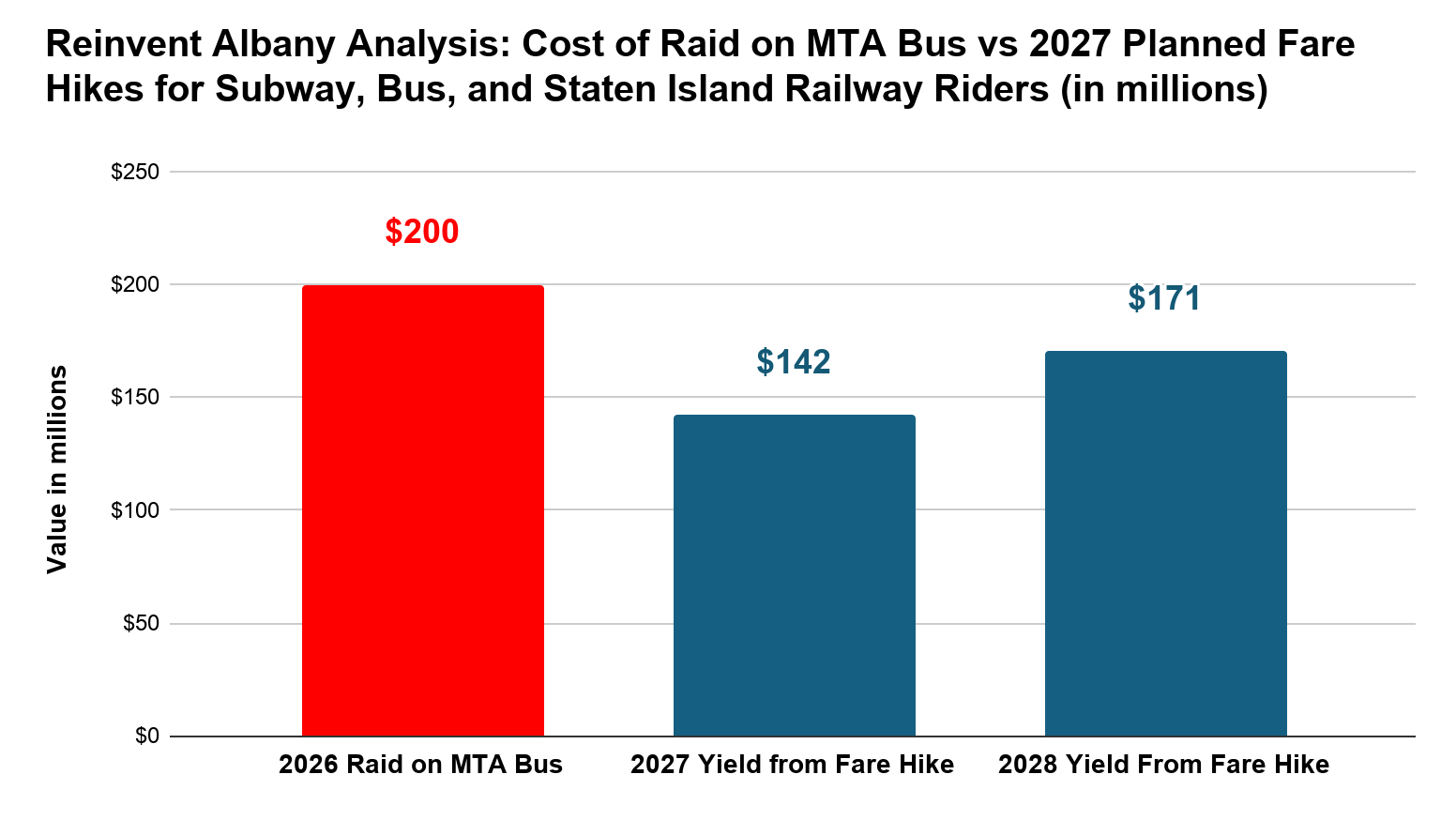
We have supported regular fare hikes; however, the magnitude of this raid is commensurate with what New York City transit riders (New York City Transit buses and subways, MTA Bus and Staten Island Railway) are expected to pay in fare increases in 2027 and 2028, as shown below.
The MTA first confirmed that it was eating the expected aid from NYC to MTA Bus in its July 2026 financial plan (emphasis added):
“The New York City FY 2027 Budget includes a one-time $200 million reduction in the City’s subsidy for the MTA Bus Company. The July Financial Plan, consistent with the City’s adopted budget, reflects a corresponding one-time reduction in the expected City subsidy reimbursement, which will be covered by MTA resources.”
However, a review of City and State financial statements suggests that, initially, New York State would pick up the tab and make the MTA whole for the $200 million loss from the City.
Reduction in Support for MTA Bus as Part of NYC Aid Package Never Publicly Disclosed
As part of the state budget agreement on May 12, 2026, Governor Hochul and Mayor Mamdani announced “an additional $4 billion in gap-closing support” for New York City. However, nowhere in the state budget bills or supporting documentation was there mention of the City’s MTA payments being forgiven or deferred as part of the package. Indeed, the announcement made it sound like the state was providing aid – that the $4 billion was “new state assistance” to the City.
In a radio interview on May 13, 2026, Governor Hochul said part of the State’s package for New York City was support for the MTA, which the City had previously paid for. From the Governor’s own transcript (emphasis added):
“So what I did to help the city, a large part of that $4 billion would allow them to focus on — give approval for pension deferrals that would just move it out a few extra years in the future, and also some direct money, but also increasing education dollars like I’ve done on Long Island and across the state, and support for some projects related to the MTA that the state had covered before but had been removed.”
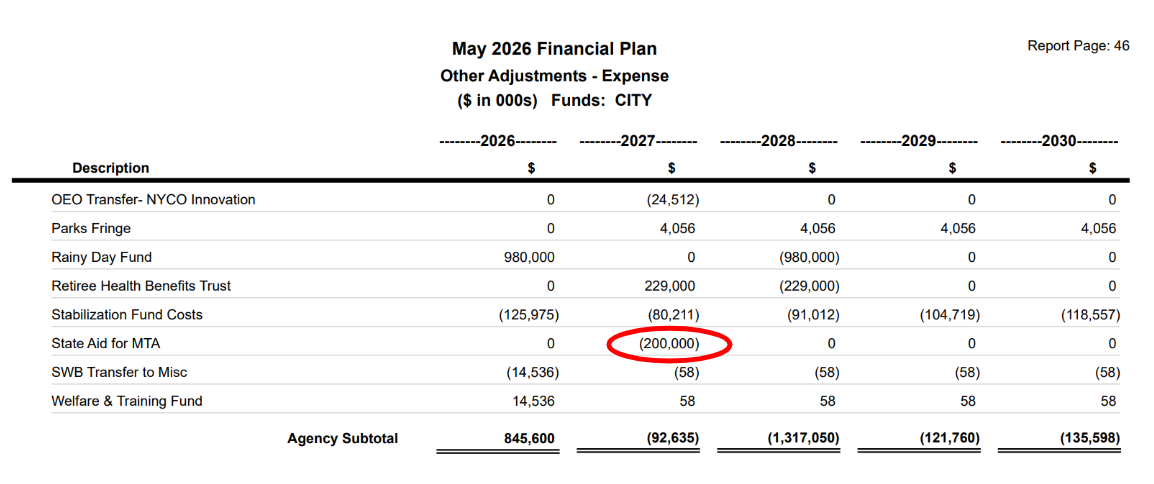
New York City’s May 2026 Financial Plan Reconciliation – showing changes to expenses since the prior financial plan – includes a reduction of $200 million in City expenses labeled as “State Aid for MTA.” See the screenshot below:
In May and June, NYC and State Comptrollers Assert State Will Pay City’s $200m Share to MTA Bus
The May 2026 Monthly Economic Newsletter published by the NYC Comptroller also described the MTA portion of the State Budget’s aid to the City as a “One-time shift to the State for $200 million in contributions to the MTA in FY 2027.” (In other words, the scheduled payment to MTA Bus would be shifted from the City to the State.)
The June 2026 review of the City’s Financial Plan published by the State Comptroller noted action “by the state” included “Funding $200 million in FY 2027 only for city-funded MTA-related costs.”
Later in June and July, NYC Comptroller and MTA Say MTA Will Absorb Loss
Beginning in June 2026, public documents began to say that New York State would not be paying the MTA instead of the City. The NYC Comptroller, in its June 2026 Comments on the FY 2026 NYC Executive Budget, said that “This change was not included in the State’s Enacted Budget and must be made in the MTA financial plan.”
The MTA later stated that it would absorb the costs of the $200 million revenue loss in its July 2026 Financial Plan, as noted above.
State’s Backdoor Raid Will Aggravate MTA’s Massive Out-Year Budget Deficits
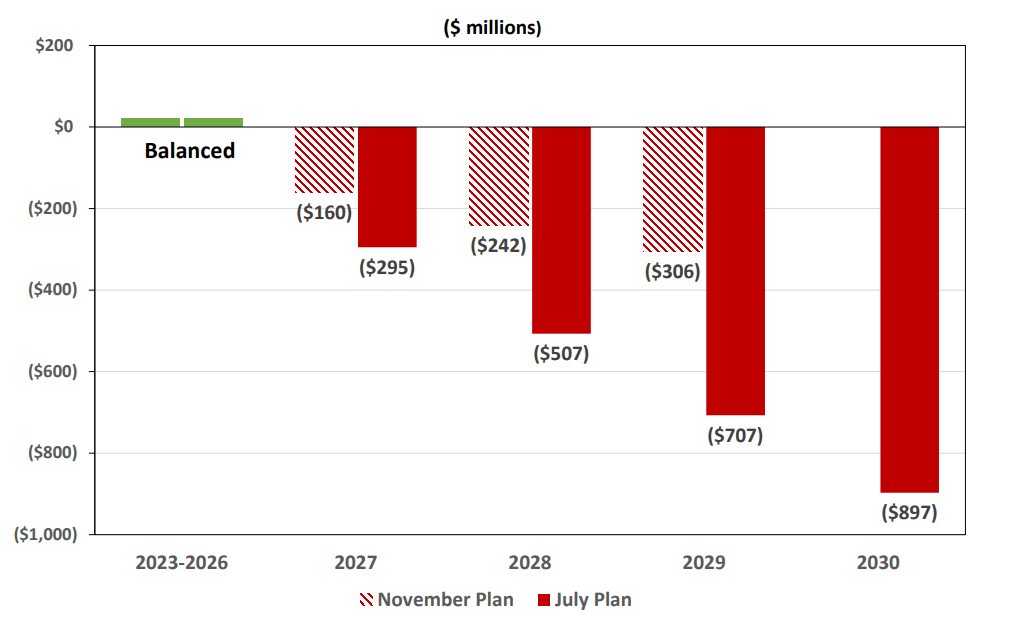
The MTA’s July 2026 Financial Plan presentation noted that large out-year deficits have worsened since the November 2025 Financial Plan. It emphasized that 93% of the costs driving the budget gaps are “uncontrollable.” See the chart below of out-year deficits.
Key Facts from MTA July Financial Plan
- 4% fare and toll increases are assumed for 2027, raising a total of $281 million in 2027, and $332 million in 2028.
- Fares for NYCT, MTA Bus Company, and Staten Island Railway alone would raise $142 million in 2027, and $171 million in 2028.
- MTA notes the risk that casino gaming taxes could bring in less revenue than expected—a potential annual loss of $140 million.
- Tier 6 pension changes from the state budget will cost the MTA $30 million a year from 2027 to 2030—however, we note that out-year costs will skyrocket due to reamortization gimmicks that push the true cost of the pension changes to 2033.
- Paratransit costs are also increasing, and the City’s contribution to MTA paratransit service is under intense negotiation. State law since 2023 has required the City to pay 50% plus up to $165 million of operating costs. This cap expires on June 30, 2027. The MTA’s July 2026 Financial Plan assumes that state law will be changed to require an 80% contribution from the City without a cap. New York City has previously opposed increases in its contribution to paratransit.
2004 MTA Bus Letter Agreement: NYC Agrees to Pay for Part of MTA Bus Operating Loss
According to bond issuance documents, in December 2004, the MTA Board approved a letter agreement with the City (the MTA Bus Letter Agreement) with respect to the establishment of MTA Bus and operation of certain bus routes (the MTA Bus System) in areas then served by seven private bus companies pursuant to franchises granted by the City. The City’s payments under the MTA Bus Letter Agreement are pledged to holders of the Transportation Revenue Bonds.
The MTA Bus Letter Agreement with the City provides for the following:
- A lease by the City to MTA Bus of the bus assets to operate the MTA Bus System.
- The City agrees to pay MTA Bus the difference between the actual cost of operation of the MTA Bus System (other than certain capital costs) and all revenues and subsidies received by MTA Bus and allocable to the operation of the MTA Bus System.
- If the City fails to timely pay any of the subsidy amounts due for a period of 30 days, MTA Bus has the right, after an additional 10 days, to curtail, suspend, or eliminate service and may elect to terminate the agreement. The City can terminate the agreement on one year’s notice.