
Listening to FOIL 2026: Lessons from 11 New York State Agencies
Table of Contents
Executive Summary
In a series of “Listening to FOIL” reports dating back to 2014, Reinvent Albany has used government agency logs of Freedom of Information Law (FOIL) requests to assess how well FOIL is working. These reports also provide a model for agencies of how they can use their own FOIL logs to guide which datasets they publish as open data.
In this report, Reinvent Albany has again analyzed the data in FOIL logs, this time from 2024, provided to us by 11 units of New York State government:
- Executive Chamber
- Division of the Budget (DOB)
- Office of General Services (OGS)
- Dormitory Authority of the State of New York (DASNY)
- Department of Environmental Conservation (DEC)
- Office of Cannabis Management (OCM)
- Office of Information Technology Services (ITS)
- Department of Public Service (DPS)
- New York State Energy Research and Development Authority (NYSERDA)
- New York State Thruway Authority (NYSTA)
- Workers’ Compensation Board (WCB)
Reinvent Albany obtained each agency’s FOIL logs via a Freedom of Information Law request. We requested the logs in machine-readable spreadsheet format and asked for detailed information about requests both opened and closed in calendar year 2024.
Agencies’ responses to our requests for their FOIL logs were their own test of FOIL compliance. While some agencies provided XLS files, as we requested, others sent PDFs. Unfortunately, three state government entities sent FOIL logs that we were unable to analyze due to poor file formats: the Long Island Power Authority (LIPA), though this was corrected after an appeal and calls from our lawyer; the NYS Department of Transportation (NYSDOT); and the Gaming Commission. The State University of New York failed to provide us with a log, saying that it had no responsive records to our request.
The Committee on Open Government (COOG) issues annual reports about FOIL and the Open Meetings Law, but it is underfunded and has a tiny staff. Reports by watchdog groups, like Reinvent Albany, remain one of the only tools the public, Legislature, and executive branch have to evaluate whether FOIL is working and whether agencies are ignoring or undermining it.
One reason for this is because, unlike the federal government, the State of New York does not track or publicly report on how well state agencies and authorities fulfill their responsibilities under the state’s Freedom of Information Law. Unfortunately, the State does not treat fulfilling FOIL requests as the important public service it is. They do not track agency FOIL activity or efforts to comply with this fundamental transparency law.
Major Findings
- FOIL volumes vary dramatically across agencies. In 2024, FOIL caseloads ranged from fewer than 100 requests (Office of Information Technology Services) to over 13,000 requests at the Department of Environmental Conservation (DEC).
- High FOIL volumes don’t have to mean long delays. The average closure time across all 11 agencies for requests opened in 2024 was 34 days, largely driven by DEC, which closed requests in 18 days on average.
- Most requests continue to be driven by businesses and law firms – not reporters or the general public. The exception is the Executive Chamber, which had 40% of requests come from the press.
- Agencies are failing to publish commonly requested records. These include contracts as well as bill jackets and more timely updates of the Governor’s schedules. The Governor’s schedules that are published online are 15 months out of date, and FOIL requests for comprehensive schedules she actually uses have been denied according to NY Focus.
- Requests taking more than 60 days to close account for a disproportionate share of total waiting time. Of requests opened and closed in 2024, 9% took more than 60 days to close. These requests accumulated 115,016 days of waiting time, equivalent to 315 years wasted by people waiting for records – a disproportionate share of 26% of all wait time for FOIL responses.
- The Governor vetoed a bill in October 2025 that would have capped response times at 60 days, saving New Yorkers time and effort.
- Most closed requests took 60 days or less – even at high-volume agencies like DEC (where 93% of closed requests took 60 days or less). The notable exception was the Office of Cannabis Management: Only 7% of their closed requests took 60 days or less, suggesting chronic dysfunction when it comes to FOIL. All other agencies had between 63% (Executive Chamber) and 99% (Workers Compensation Board) of closed requests take 60 days or less. Note that this analysis does not include 2024 requests that remained open at the end of the year, so the percentages may be lower for some agencies.
- This shows that most state agencies could implement the bill vetoed by the Governor with only modest additional effort – and outliers are likely in need of improvement anyway.
- Across all 11 agencies, 90% of FOIL requests created in 2024 were closed by year’s end. However, some agencies had backlogs:
- The Office of Cannabis Management closed only 14% of 2024 requests within that same year. The Executive Chamber closed 80%, and the Department of Public Service (DPS) closed 81%.
- The FOIL logs received by Reinvent Albany varied in quality and usefulness. Some agencies sent detailed XLS files, and others sent blurry PDFs that we could not analyze. One agency, SUNY, said it does not maintain a FOIL log at its headquarters.
- Most agencies are not using GovQA features that the state is already paying $650,000 a yearfor: electronic acceptance of appeals and FOIL archives that publish frequently requested records.
- Ten agencies (50% of the 20 we examined) require appeals to be submitted by hard-copy mail. Only two agencies used GovQA’s built-in appeals feature (NYS Department of Health, NYS Police).
- Agencies are not using the “FOIL Archives” feature – though ITS used the “Trending Topics” feature on GovQA to publish six contracts, the links were dead. However, this is significantly less than the 24 contracts published on ITS’s FOIL website.
Summary of Recommendations
We recommend that the Legislature pass, and the Governor sign, the following bills:
- Report FOIL Activity (S452 (Hoylman-Sigal) / A2321 (McDonald))
- Limit Commercial FOIL Exemption (S5000 (Hoylman-Sigal) / A1410 (Rosenthal))
- Strengthen FOIL Attorneys’ Fees (A950-A (Steck) / S1418-A (Liu))
- Reduce Agency FOIL Response Time (S2520-B (Skoufis) / A3425-A (Raga))
- Legislation requiring FOIL appeals to be submitted electronically
Read more in our Recommendations section below.
Introduction
Reinvent Albany advocates for transparent and accountable New York government. We work to strengthen the Freedom of Information Law (FOIL) and put government information online. We advocate for government open data and the laws, practices, and funding to make it happen.
We believe all government agencies in New York should consider providing public records requested via the Freedom of Information Law to be a core service rather than an afterthought or arbitrary burden. We think agencies should be required to publicly disclose basic details about how well they are providing FOIL records as a mission-central customer service. Agencies have been subject to FOIL since the 1970s. By now, agencies should have well-managed, adequately staffed FOIL processes. Agencies should be data-driven and continuously improving so the administrative burden is as minimal as possible – while ensuring good customer service.
It is troubling that there is no effort at the state level to learn how FOIL is working across all agencies. As noted in our reports reviewing the Governor’s transparency plans, there was a missed opportunity for the Governor to collect data about agency FOIL response times to assess how agencies can better respond to FOIL requests. And while the comptroller’s office audits agencies from time to time about FOIL requirements, such as a 2023 audit of the NYS Department of Transportation and a 2020 audit of the Capital District Transportation Authority, the comptroller’s office does not examine each agency or authority’s FOIL compliance.
To evaluate how well FOIL is working and how to improve it, Reinvent Albany regularly looks at the FOIL logs of records requests received by state and local agencies. Our past reports on FOIL and NYS government transparency include:
- Listening to FOIL 2025 Report: Lessons from Five NYS Agencies (June 2025)
- New York City Government Flouting Freedom of Information Law (April 2025)
- Opening New York 2024: Rating 66 Agency Transparency Plans (May 2024)
- Listening to FOIL 2024: Lessons from Six NYS Agencies (March 2024)
- Opening New York 2022: Rating 70 State Agency Transparency Plans (March 2022)
- Legislative FOIL: A Tale of Two Houses (December 2020)
- FOIL that Works: Increasing MTA Transparency and Accountability by Putting Foil Online (October 2018)
- Listening to FOIL: NYC DOITT (November 2015)
- Beyond Magic Markers: Faster, Less Expensive Freedom of Information Law in New York City (June 2014)
This report continues this important work, looking at 11 agencies’ FOIL logs for 2024. Reinvent Albany obtained the agency FOIL logs via Freedom of Information Law request. We requested the logs in machine-readable spreadsheet format, and asked for detailed information about requests either opened or closed in calendar year 2024: the date of request; name of requester; affiliation of requester; subject of request; date of acknowledgement; number and dates of extensions/responses; status of request; date request closed; whether request was responded to in full, partially, or denied; and exemptions cited in response, if any.
Our requests for agency FOIL logs were themselves an important test of those agencies’ responsiveness to requests for records. For this report, Reinvent Albany sent FOIL log requests to 20 agencies. Three requests for FOIL logs remained unfulfilled: Department of Labor, New York State Police, and Department of Health. These requests were submitted in June 2025, more than four months ago. Two agencies (the Department of Corrections and Community Supervision and the New York Power Authority/Canal Corporation) sent FOIL logs too close to publishing time for Reinvent Albany to fully analyze FOIL activity for this analysis; they will be covered in a future report.
Of the 15 agencies that closed our requests for FOIL logs:
- Five agencies provided XLS files that allowed for quick analysis: the Division of the Budget (DOB); the Office of General Services (OGS); the Dormitory Authority of the State of New York (DASNY); the Thruway Authority, and Workers’ Compensation Board (WCB).
- Three agencies sent poorly formatted PDF FOIL logs that we were unable to analyze – and only one corrected the file. These logs were sent in PDF image file formats that were too blurry for OCR software or too inconsistently formatted to convert into spreadsheet format. Some were hundreds of pages long, rendering manual review infeasible. These agencies included the Long Island Power Authority (which eventually corrected the file format), NYS Department of Transportation, and Gaming Commission.
- Six agencies provided PDF FOIL logs that required conversion in order for Reinvent Albany to analyze them: the Department of Environmental Conservation (DEC), Office of Cannabis Management (OCM), Executive Chamber, NYS Information Technology Services (ITS), Department of Public Service, and the New York State Energy Research and Development Authority (NYSERDA). They either were in machine-readable formats, or we were able to use modern optical camera recognition (OCR) software to convert them.
- One agency failed to provide any FOIL log, essentially saying that they don’t have one. The State University of New York’s response said: “Please be advised that SUNY System Administration does not have possession of records responsive to your request and no responsive records can be found following a diligent search.” SUNY’s administrative office does not use GovQA, but rather accepts FOIL requests via a contact form on their website that is used for a variety of inquiries.
The poor quality of the FOIL logs provided by a number of agencies is completely at odds with the modern FOIL software that most agencies have now deployed in accepting and managing records requests.
In March 2022, Granicus LLC – a government software company – was awarded a contract with the State of New York to provide the FOIL software GovQA. The $650,000 annual cost includes required development of several features that should make it easy for agencies to provide the information that Reinvent Albany requested regarding their FOIL logs. Specifically, the contract scope requires:
- The ability to import or export data in piecemeal or in its entirety at no charge to authorized users. This includes the ability to import or export data to/from other contractors and for data to be exported in a JSON or other standard format.
- This means that agency staff should have the ability to export logs of requests in the spreadsheet format that we requested.
- Ad hoc reporting capability for certain agency users.
- This means that agency staff should also be able to generate custom reports about the status of requests.
- Appeals to be accepted on the portal. This means that agencies that are requiring requesters to mail hard-copy appeals are choosing not to take advantage of a software function that New Yorkers have already paid for.
Appendix A provides a summary of the completeness of FOIL logs provided by agencies.
Agency Comparison – How 11 NYS Agencies Responded to FOIL Requests
Below is a summary of FOIL caseloads for the 11 agencies covered in this report. By far, the DEC received the largest volume of requests in 2024 – over 13,000 – followed by the Executive Chamber and WCB. All agencies closed over 90% of requests created in 2024 by the end of the year, with the exceptions of DPS (closing 81%), the Executive Chamber (closing 80%), and OCM (closing just 14%).

How quickly did agencies respond to new requests? Below is a summary of average response times in days for FOIL requests submitted in 2024. Note that this undercounts average response times, as it excludes requests made prior to 2024 but which are still open. (We did not have pre-2024 requests for all agencies, and were unable to make this comparison across all agencies.) Also note that agencies sometimes classify a request as “closed” even if the requester believes the agency did not provide all or most of the records they asked for.
OCM took the longest to close FOIL requests from 2024, taking on average 127 days, followed by the Executive Chamber (42 days) and NYSERDA (36 days); the average closure time among all 11 agencies was 34 days. The fastest was WCB, closing requests in just 4 days, on average.

While most requests are closed in around a month, New Yorkers continue to waste time waiting for FOIL requests to be answered. In December, Governor Kathy Hochul vetoed a bill (S2520-B (Skoufis) / A3425-A (Raga)) that would have required agencies to respond to FOIL requests in a more timely manner. The bill would have phased in a time limit for requests, ultimately requiring agencies to respond in 60 days or less. Some agencies, particularly OCM, the Executive Chamber, NYSTA, and NYSERDA, have significant shares of requests taking longer than this. Among requests opened and closed in 2024, 1,490 took longer than 60 days. These requests accumulated a total of 115,016 days, or 315 years, of extra waiting until their eventual close. Despite making up around 9% of requests, those that took more than 60 days accounted for over a quarter (26%) of time spent waiting.
Conversely, one could look at these wait times and see that most requests take fewer than 60 days – what the FOIL timing legislation would have required. Many agencies – including those with huge volumes, like DEC – would be able to easily implement the legislation.

Special Focus: Agency FOIL Appeals
Reinvent Albany submitted requests to 20 agencies for their 2024 logs, including some agencies not profiled in this report (either because we did not receive the logs in time for this report or because we were unable to use what the agencies provided). For all 20 agencies, we took a look at their processes for accepting appeals.
Under the Freedom of Information Law, requesters who disagree with an agency’s decision about their FOIL request – for example, when the request was denied in full or in part – may appeal at the agency level. Requesters may also choose to appeal when an agency has failed to acknowledge the request or respond in a timely manner, rendering it “constructively denied.”
The appeals process is spelled out in Section 89(4) of Article 6 of the Public Officers Law. Beyond the ability to appeal denials, it provides requesters with an option to appeal based on agencies’ failure to conform with the requirements of the law regarding timelines for responses (emphasis added below):
Except as provided in subdivision five of this section, any person denied access to a record may within thirty days appeal in writing such denial to the head, chief executive or governing body of the entity, or the person therefor designated by such head, chief executive, or governing body, who shall within ten business days of the receipt of such appeal fully explain in writing to the person requesting the record the reasons for further denial, or provide access to the record sought. In addition, each agency shall immediately forward to the committee on open government a copy of such appeal when received by the agency and the ensuing determination thereon. Failure by an agency to conform to the provisions of subdivision three of this section shall constitute a denial.
Unfortunately, the law does not specify the manner in which appeals may be submitted beyond stating that they must be in writing. While FOIL requests are required to be accepted via electronic mail if the “entity has reasonable means available,” the law is silent on electronic submission of appeals.
The state’s contract with Granicus for the GovQA platform explicitly requires that the software include an “appeals feature so that the public can appeal a FOIL result.” Despite this requirement, most agencies surveyed in this report are not using the feature – despite the state paying $650,000 a year for software that must include it (among many other features).
Unfortunately, a number of agencies do not provide either an email address or electronic means of appealing: 10 of the 20 agencies (50%) whose policies we examined stated that appeals must be mailed in writing. Six of the 20 agencies (30%) clearly stated that appeals are accepted via either email or the GovQA portal. (Only two actually used their GovQA portal for this feature: the NYS Police and NYS Department of Health.) Another four agencies provided either unclear or conflicting information about whether appeals are accepted electronically. One agency failed to provide any information about appeals – the State University of New York.
Our full review of agencies’ appeals processes is provided as Appendix B.
Recommendations
Since 2024, Reinvent Albany has joined journalism groups, transparency advocates, and government watchdog groups to urge the Legislature to pass a package of four bills to strengthen the Freedom of Information Law. Our groups strongly agree that FOIL is working poorly, and some of us, including Reinvent Albany, believe FOIL is dysfunctional. This new effort succeeds many prior attempts to reform FOIL.
Eighteen of our groups sent a Sunshine Week letter to New York’s Legislative leaders urging them to pass the four bills. Laudably, the Assembly passed three of these bills, but none became law after either failing to pass the Senate, or being vetoed by the Governor.
- Report FOIL Activity (S452 (Hoylman-Sigal) / A2321 (McDonald)) – Passed the Assembly in June 2024 and again in March 2025.
- Limit Commercial FOIL Exemption (S5000 (Hoylman-Sigal) / A1410 (Rosenthal)) – Passed the Senate in 2024 and the Assembly in March 2025.
- Strengthen FOIL Attorneys’ Fees (A950-A (Steck) / S1418-A (Liu)) – Passed the Senate in May 2025, died in Assembly.
- Reduce Agency FOIL Response Time (S2520-A (Skoufis) / A3425 (Raga)) – Passed both houses in June 2025, then was vetoed by the Governor. Reinvent Albany strongly criticized the Governor for vetoing what we said was the most consequential FOIL bill to pass the Legislature in years.
The Legislature should also introduce and pass legislation to require FOIL appeals to be allowed to be submitted electronically by email as well as through the FOIL portal/software used by agencies to accept FOIL requests.
For individual recommendations for each agency, please see the agency-specific sections below.
Individual Agency Analysis
Executive Chamber
As the chief executive of the state, the Governor’s responses to FOIL requests are heavily scrutinized by the press. The Governor also sets FOIL policy throughout the state through both administrative action and legislation. Unfortunately, although Governor Hochul initially indicated an interest in government transparency after taking office and initiated a “transparency plan” process with agencies, the plans were incomplete and haphazard and allowed agencies to self-report about their transparency initiatives. Additionally, Governor Hochul vetoed the most promising FOIL bill in years, which would have greatly improved response times from agencies.
The Executive Chamber – perhaps better known as the “governor’s office” – maintains a FOIL website and accepts requests through the state’s GovQA platform. It accepts appeals via email and includes the full names of both its FOIL and appeals officers on its website, along with their mailing addresses and emails.
The Executive Chamber FOIL website contains a small list of “Frequently FOILed Documents” – the chamber’s aircraft policy, vehicle use policy, and a staff list (note that this document is currently dated October 29, 2024). However, a review of the FOIL requests submitted to the Executive Chamber in 2024 makes it clear that the most commonly requested documents, such as the Governor’s schedule and bill jackets, are not on this list. New York Focus reported on January 20, 2025 that the Governor’s publicly available schedules are currently 15 months out of date, and FOIL requests for the Governor’s comprehensive calendar that she actually uses have been denied on the basis that it’s “subject to change.”
Volume of Requests
The Executive Chamber received 540 FOIL requests in 2024 and closed 524 during this period. (This includes some requests first submitted in 2023.)
Who Is Requesting Records?
The majority of requests to the Executive Chamber received in 2024 (including those received in 2023 and closed in 2024) were evenly split between requests from the press (266 requests, or 40% of the total) and from unknown or individual requesters (253 requests, or 38%). The share of Executive Chamber requests by the press is much higher than for any other agencies analyzed. Nonprofit advocacy groups, academics, unions, and political parties made 70 requests, 8% of the total. Law firms, government, and businesses made up smaller percentages of the total.

By far, the largest share of requests were for emails or other communications by the Governor and her staff (181 requests, or 34%). A surprising number of requests came in for records that were eventually made public, but not in a timely manner – 34 requests (5%) were for legislative bill jackets or other legislative memoranda, and 22 requests (4%) were for the calendars or schedules of the Governor or her staff. (Only past schedules are published online; they have not been updated since September 2024 as of the writing of this report.)
Regarding bill jackets, the governor sends legislative materials to the New York State Library for publishing, but these are not made public in a timely manner, and the NYS Archives site for accessing them is difficult to use. Unfortunately, only bill jackets from 2022 and prior are currently published on this site. We note that the New York State Library is part of the New York State Education Department, which is not controlled by the Governor but rather the Board of Regents that is appointed by the Legislature.
Response Times
Of requests opened in 2024, the average response time was just over two months (68 days), slower than for most other agencies analyzed. More than half of requests (55%) were closed in 30 days or less. Requests closed in one to three months made up 17% of all closed requests, and those closed in three to six months another 17%. Another 11% took longer than six months to close, with a small number taking between one and one-and-a-half years (nine requests, or 2%).

Recommendations
- Use the GovQA platform to proactively publish public records that have been released via FOIL – “release to one, release to all.” (This could be timed to publish 14 days after being provided to the requester, as required in New York City.)
- Allow appeals through the GovQA portal while continuing to accept appeals via email.
- Immediately send all 2023 and 2024 bill jackets to the NYS Library/NYS Archives for publishing and work to send 2025 bill jackets in a more timely manner.
- Immediately publish the Governor’s schedules from July 2024 to September 2025 and publish new schedules within 30 days of the close of each month.
- Update the Governor’s staff list and ensure it is updated every quarter.
- Identify additional datasets for publishing on the NYS Open Data Portal.
Division of the Budget
The Division of the Budget maintains a FOIL website and uses GovQA to accept requests. While the FOIL website states that appeals may be submitted through the GovQA portal, there is no means to do so, and the portal instead provides a mailing address. The GovQA portal includes a button for the “FOIL Records Archive,” a feature that allows agencies to publish records released through FOIL to the public, but no records are accessible on the resulting page. The “Trending Topics” button on the GovQA portal also leads to a blank page.
Volume of Requests
As occurred previously in response to Reinvent Albany’s request for 2023 FOIL logs, it appears that the Division of the Budget only sent Reinvent Albany the number of requests that were closed by the agency in 2024, rather than the total number of requests received in 2024. All of the 124 requests listed on the log as received in 2024 were closed, and the log included no records that were received later than November 20, 2024. The log included seven requests from 2023 that were closed in 2024, for a total of 131 requests closed in 2024. DOB’s 2023 FOIL log showed that 81 requests were received by the agency in 2023. (See “Listening to FOIL 2024” for more details.)
We note that partial FOIL logs are published by the DOB on its FOIL website, though these do not include the dates of receipt and closure. DOB’s 2024 FOIL log as provided on its website includes 113 requests.
Who Is Requesting Records?
Reinvent Albany was unable to classify 56% of requests. The most common affiliations of requesters that could be identified were the press (15%), followed by nonprofits/advocacy groups (10%), businesses (9%), and law firms (6%). Unsurprisingly, the most common records requested related to state payments, budget records, and contracts. These requester types match those present in the 2023 log.

Response Times
The Division of the Budget closed all requests provided on the log within nine months. The average closure time of requests made in 2024 was 22 days; this is faster than the division’s 39-day average in 2023. More than three-quarters (76%) were closed in 30 days or less; 16% were closed in between one and three months; 7% were closed in between three and six months, and 1% took between six and nine months.

We credit the DOB for providing detailed records about the outcomes of closed requests; this data illuminates the number of requests in which records were actually sent, as well as denials or referrals to other agencies. A table of outcomes is provided below, along with the average closure times in each category. (Reinvent Albany used the outcomes as reported by DOB.) The most common outcome was that there were no records: This accounted for 90 requests (69%), which were typically closed within two weeks. (For 10 of these, DOB asked for but did not receive a revision to the request.) Records were simply sent in 26 requests (20%), which took a little over two months to complete on average.
| Outcome of Closure | Number of Requests | Average Days to Closure |
| No records | 80 | 14 |
| Records sent | 26 | 64 |
| No records; revised request not received | 10 | 10 |
| Withheld; appeal denied | 4 | 51 |
| Referred to other agency | 4 | 13 |
| Withheld | 2 | 70 |
| Records sent; appeal denied | 1 | 23 |
| Partial denial | 1 | 142 |
| Not a FOIL | 1 | 7 |
| No payment sent | 1 | 16 |
| Certification required, not sent | 1 | 7 |
| Total | 131 | 26 |
Recommendations
- Use the GovQA platform to proactively publish public records that have been released via FOIL – “release to one, release to all.” (Could be timed to publish 14 days after being provided to the requester, as required in New York City.)
- Identify additional datasets for publishing on the NYS Open Data Portal.
- Better publicize and expand the Open Budget website offerings, which provides state budget information in an open data format.
- Make clearer on DOB’s FOIL website which contract data DOB holds and which is held by the Office of General Services or other agencies.
- Accept appeals via the GovQA portal and email and provide the name and contact information for the DOB Appeal Officer in the portal and on DOB’s website.
- Provide more timely updates of the Discretionary Lump Sums website, which as of this report was last updated on August 8, 2025.
- Consolidate discretionary funding information from SUNY, CUNY, and DASNY and publish as data rather than as PDFs, and provide it on the DOB Discretionary Lump Sum website rather than linking to respective agency web pages.
Office of General Services
The Office of General Services (OGS) is responsible for a lot of high-dollar value activity of state government, including: managing and leasing real property; designing and building facilities; and contracting for goods, services, and technology. OGS is the primary agency that contracts for other agencies of state government, so FOIL requests for contracts of individual agencies are often redirected to OGS. For example, the ITS contract for GovQA was obtained by Reinvent Albany through a FOIL request to OGS. Therefore, its FOIL practices are especially important, as they hold a great deal of crucial information about the expenditure of taxpayer dollars.
OGS maintains a FOIL website and uses GovQA to accept requests. Both the FOIL website and GovQA portal direct requesters to appeal OGS FOIL determinations through hard-copy mail. However, there is an email address to accept FOIL requests. Additionally, the GovQA portal for OGS provides a “FOIL Archive” button, but no records have been released to the public through this feature.
Volume of Requests
In 2024, OGS received 414 FOIL requests and closed 454. This represents the agency working through a backlog of cases from the year prior, as the agency also provided records of cases closed in 2024 but opened in 2023 (69 such requests). We note, however, that 19 entries in the dataset had redacted creation dates.
Who Is Requesting Records?
Of the 483 requests opened in 2024 (plus the additional 69 requests closed in 2024 but opened in 2023), the largest share, 221, came from unknown requesters or individuals (47%), followed by 178 from businesses (36%) and 45 from law firms (9%). All other requester groups made up a small percent of the total.

OGS also provided the status of the FOIL requests closed. Of all requests, 52% were fully or partially fulfilled by the agency, followed by 39% that had no records found, and a remaining 9% that were either withdrawn by the requester, denied, or had some other outcome. Unknown or individual requesters had lower rates of requests fully or partially released, just 37%. Businesses and law firms had higher rates, at 62% and 70%, respectively.
Response Times
The typical time to close an OGS request was just under a month, at 27 days. The vast majority of cases, 77%, were closed in 30 days or less, followed by 21% closed within one to three months of opening. Only 2% of requests remained open longer than this, and all requests closed in 2024 were closed within six months.

We note, however, that there were 29 requests opened in 2024 but not closed that year, and we are unable to ascertain how long these cases have been open for, as we do not yet have 2025 data. Additionally, there are 19 requests we do not have an opening date for.
The average days to close was similar for the most common requester types: 17 days for law firms, followed by 26 days for both unknown or individual requesters and businesses. Press FOIL requests took the longest, at 63 days, but there were only 12 such requests closed in 2024.
Recommendations
- Use the GovQA platform to proactively publish public records that have been released via FOIL – “release to one, release to all.” (Could be timed to publish 14 days after being provided to the requester, as required in New York City.)
- Publish a dataset of all debarred and nonresponsible entities published by OGS as required by Executive Order 192 of 2019, as open data.
- Identify additional datasets for publishing on the NYS Open Data Portal.
- Accept appeals via the GovQA portal and email and provide the name and contact information for the OGS Appeal Officer on the portal on OGS’s website.
- Publish frequently requested contracts on the OGS website and work toward publishing all OGS contracts.
Dormitory Authority of the State of New York
The Dormitory Authority of the State of New York (DASNY) is New York State’s public finance and construction authority. It is a public benefit corporation that issues debt to finance, design, and build infrastructure projects for the state. It had nearly $56 billion in debt outstanding in 2024, according to the Authorities Budget Office – the most of any state authority.
DASNY maintains a FOIL website and accepts requests through the state’s GovQA platform. While an email is provided for FOIL request submission, the DASNY FOIL website provides only a mailing address for appeals. The GovQA portal also provides only a mailing address for appeals. Additionally, while the GovQA portal provides a button for “Trending Topics” on its home page, it yields no search results.
Volume of Requests
In 2024, DASNY received 165 FOIL requests and closed 163. Of these closed requests, just seven represent requests opened prior to 2024.
Who Is Requesting Records?
DASNY FOIL requests were relatively evenly split between unknown or individual requesters with 52 requests (30%), law firms with 47 requests (27%), businesses with 35 requests (20%), and nonprofits or academics with 24 requests (14%).

Response Times
The average response time for requests closed in 2024 was just under one month, at 26 days. The majority, 67% of requests, were closed within a month, followed by 30% closed in one to three months after opening. Just 2% of requests took longer than three months, with none taking longer than six months.

Recommendations
- Use the GovQA platform to proactively publish public records that have been released via FOIL – “release to one, release to all.” (Could be timed to publish 14 days after being provided to the requester, as required in New York City.)
- Identify additional datasets for publishing on the NYS Open Data Portal. Currently, DASNY only publishes four datasets on data.ny.gov.
- Specifically, DASNY should publish tabular data present in its grant administration reports, which is currently published only in PDF reports.
- Accept appeals via the GovQA portal and email and provide the name and contact information for DASNY’s Appeal Officer on the portal and on DASNY’s website.
- Publish frequently requested contracts on DASNY’s website and work toward publishing all contracts.
Department of Environmental Conservation
The Department of Environmental Conservation (DEC) manages New York State’s environmental programs and laws, including efforts to reduce pollution, address climate change, and preserve and protect open space and wildlife.
It maintains a FOIL website and uses the GovQA platform to accept requests. The website includes links to sources of information for DEC records in an effort to deflect requests for information that is already published online, including open data and information about spills and hazardous waste facilities.
While the FOIL website provides an email address for submitting appeals, this is not included on the GovQA platform in the Frequently Asked Questions section – only a mailing address is provided for appeals submissions.
Volume of Requests
In 2024, DEC received 13,205 requests, by far the highest of the agencies analyzed for this report. That same year, 12,328 requests were closed, with an additional 877 requests received in 2024 closed in 2025. We note, however, that DEC did not provide us with requests that were opened in 2024 or prior but not yet closed.
Who Is Requesting Records?
The majority, 63% of requests, came from businesses. Most concern environmental site assessments or records about spills (reports identifying environmental hazards at specific addresses). The second largest category comes from individuals or people who did not list an affiliation, 29%. The remainder are a small percentage; however, it’s worth noting the volume of these requests is still much higher than other agencies. For example, despite press requests being just 1% of the total, DEC closed 122 of them, much more than any other agencies.

Response Times
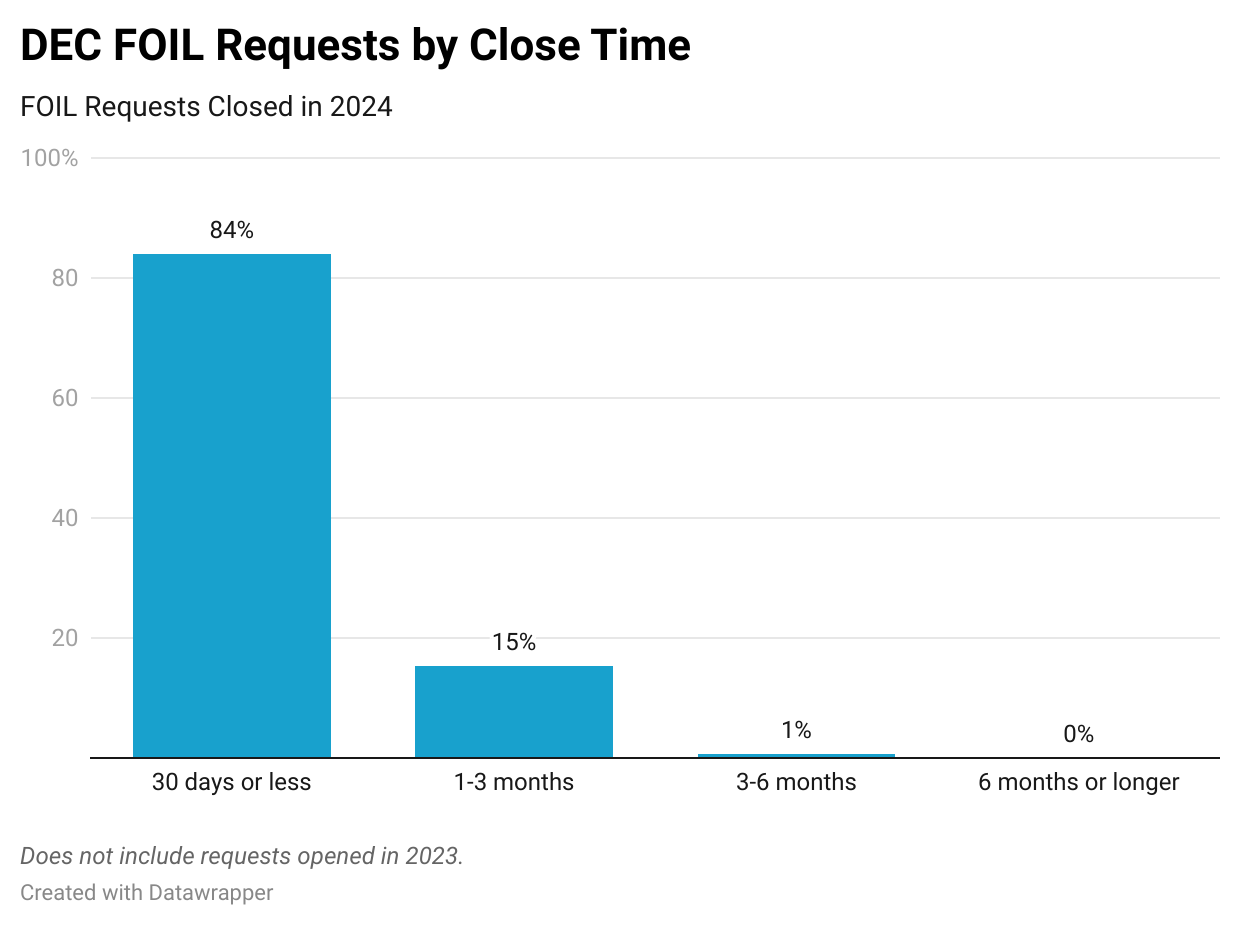
Despite the large volume of requests, DEC took only 18 days to close requests on average. Most requests closed in 2024 were done within 30 days (84%), followed by 15% of requests taking between one and three months and 1% of requests between three and six months. A negligible amount took longer than six months (17 out of more than 12,000 requests that were closed in 2024).
(continue here and down to add datawrapper charts)
Recommendations
- Use the GovQA platform to proactively publish public records that have been released via FOIL – “release to one, release to all.” (Could be timed to publish 14 days after being provided to the requester, , as required in New York City.)
- Better advertise the databases DEC offers on spills and consider making more spill information available through open data.
- Identify additional datasets for publishing on the NYS Open Data Portal.
- Accept appeals via the GovQA portal while continuing to accept appeals via email and provide the name and email address for FOIL and appeals officers on the FOIL website and GovQA portal.
- Publish frequently requested contracts on DEC’s website and work toward publishing all contracts.
Office of Cannabis Management
The Office of Cannabis Management (OCM) is a relatively new agency, first created after passage of the Marijuana Regulation and Taxation Act (MRTA) in 2021. Despite having a relatively small staff of 274, the public profile of the agency is outsized due to interest in the rollout of New York’s cannabis program. (The Office of General Services has 1,994 staff, and the Division of Homeland Security and Emergency Services has 770 staff, by comparison.) It is therefore not surprising that its FOIL process and performance is the spottiest of the agencies profiled in this report.
Reinvent Albany and other watchdog and legal services organizations requested that DASNY and OCM publish information about its Conditional Adult-Use Retail Dispensary (CAURD) loan program on October 3, 2024. The loans provided to CAURD licensees have received considerable scrutiny and been called “predatory” by legislators who created the state’s cannabis law. Ultimately, DASNY published the documents on its website, but OCM did not.
The FOIL page on the OCM website includes basic information about the FOIL process and a link to the GovQA portal managed by the agency. However, the page and portal do not include an email address or electronic means of appealing FOIL determinations by OCM. Like many other agencies profiled in this report, the “FOIL Request Archive” and “Trending Topics” buttons on the GovQA portal are not functional.
The OCM FOIL website only proactively publishes one frequently FOILed record: Cease and Desist Letters that were sent to illegal cannabis stores, though the OCM website has a number of other records and datasets of public interest.
Volume of Requests
The log provided by OCM includes requests as far back as 2022, including a number that have not yet been closed. It is clear that the agency has a large backlog of requests that it is attempting to manage. The table below includes data contained in the log sent to Reinvent Albany on July 1, 2025. The agency received 339 requests in 2024 and closed just 73 in that same year. However, the agency has worked through a substantial backlog in 2025, closing 548 requests as of July 1 (leading to 317 requests received in 2024 now being closed, and just 22 remaining open). Note that four requests from 2024 and 2025 are not included below; the logs provided a closure date while saying the request was also “open” – given this inconsistency, they are not included.
| Year Request Sent | Closed | Open | Total |
| 2022 | 20 | 3 | 23 |
| 2023 | 189 | 2 | 191 |
| 2024 | 317 | 22 | 339 |
| 2025 | 155 | 25 | 180 |
| Total | 681 | 52 | 733 |
Who Is Requesting Records?
Businesses, including dispensaries and cannabis producers, were the top requesters of OCM records, representing 26% of all requesters since 2022. Law firms came next at 13%, followed by the press at 13%; all other requester groups were minimal. Note that we were unable to classify 42% of requesters.

Response Times
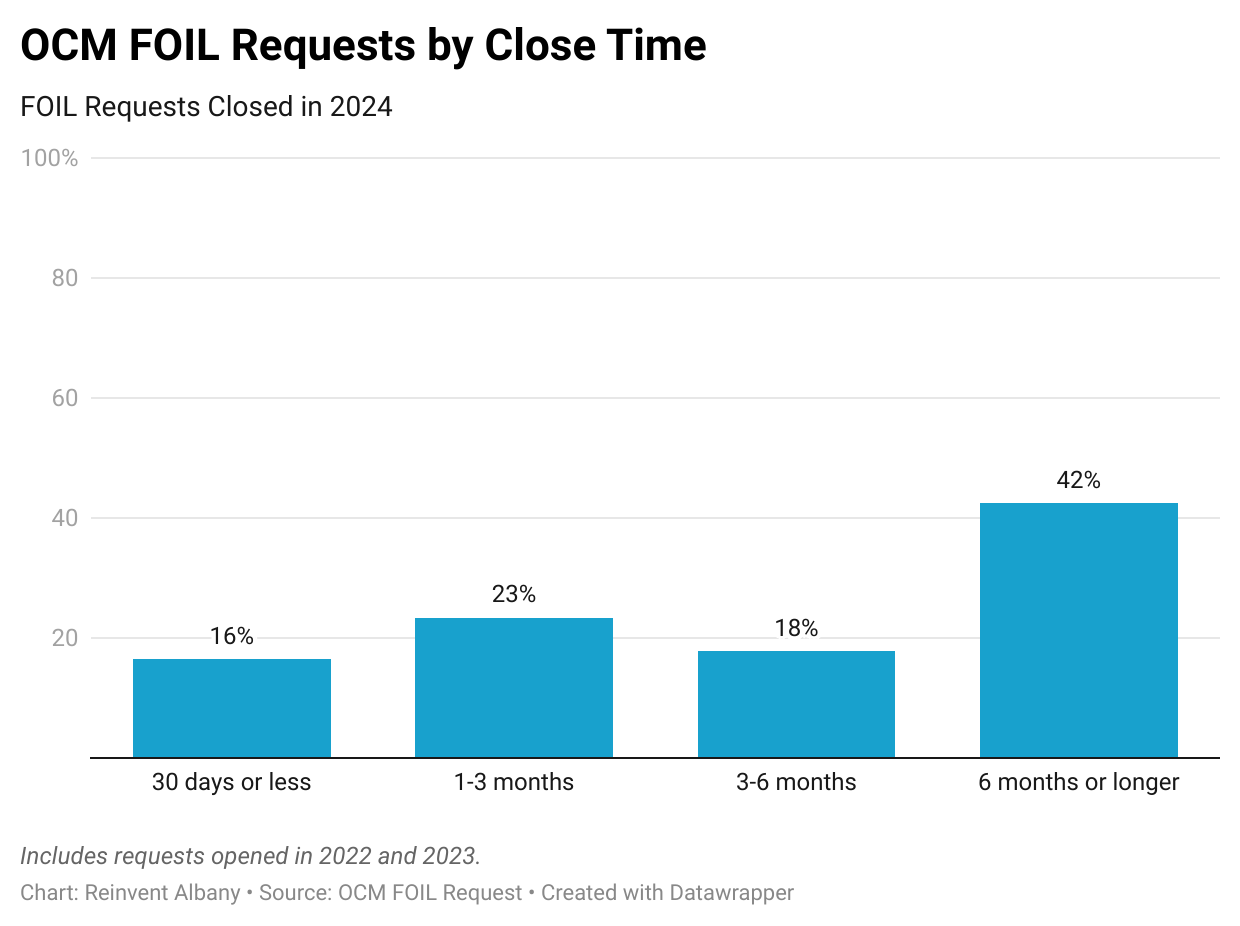
As noted above, OCM had a large backlog of requests, and it still has a number of requests left open from past years. For those records that were closed from 2022 to 2024, most were completed within 30 days or less (23%), and 72% were closed within a year of submission. However, of requests closed in 2024, just under half (42%) were closed within six months and the average response time was 225 days, reflecting that most of these requests were not closed until 2025.
Recommendations
- Clear the backlog of FOIL requests, so that new requests can be responded to more quickly.
- Use the GovQA platform to proactively publish public records that have been released via FOIL – “release to one, release to all.” (Could be timed to publish 14 days after being provided to the requester, as required in New York City.)
- Provide a link to the available OCM open data on the open data portal on OCM’s website. For example, a list of dispensaries on the OCM website is also on open data, but it is not exportable.
- Identify additional datasets for publishing on the NYS Open Data Portal, such as those showing enforcement matters or incidents. Currently, the only datasets available are four listing cannabis licensees and providers.
- Accept appeals via email and the GovQA portal and provide the name and contact information for the records and appeals officers on the portal and on OCM’s website.
- Publish frequently requested contracts and agreements on OCM’s website and work toward publishing all contracts and agreements.
Office of Information Technology Services
New York’s technology platforms are managed by the Office of Information Technology Services (ITS). Reinvent Albany has requested via FOIL several contracts related to IT systems from the agency, such as the contract for GovQA, but instead has been directed to OGS to submit the request.
The FOIL page on the ITS website includes basic information about the FOIL process and a link to the GovQA portal managed by the agency. As might be expected of a technology agency, requesters are able to appeal by email. However, ITS does not accept appeals through the GovQA portal.
Like other agencies profiled in this report, there is a button to access the “FOIL Request Archive” on the GovQA platform, but no content is available. However, the “Trending Topics” button lists six frequently requested contracts, including for IBM, Cabling Services, and the Excelsior Pass, but unfortunately, links are all dead. This page also has a feature to allow users to request automatic updates. The FOIL website also includes frequently requested contracts, providing a total of 24. This is significantly more than the six provided on the GovQA portal.
Volume of Requests
ITS received 96 requests in 2024. In that same year, 106 were closed.
Who Is Requesting Records?
The largest share of requests, 48 (44%), were from individuals or requesters who did not disclose their affiliation, followed by businesses, with 36 requests (33%), and the press, with 12 requests (11%). The remaining are a trivial number from government, law firms, and nonprofits.

Response Times
Of requests opened in 2024, the average response by ITS was 18 days. The majority, 76% of requests, were closed within a month. Another 5% of cases were open for six months or longer.

Recommendations
- Use the GovQA platform to proactively publish public records that have been released via FOIL – “release to one, release to all.” (Could be timed to publish 14 days after being provided to the requester, as required in New York City.)
- Identify additional datasets for publishing on the NYS Open Data Portal.
- Accept appeals via the GovQA portal while continuing to accept appeals via email and provide the name and contact information for the records and appeals officers on the FOIL website and GovQA portal.
- Expand the number of contracts published on the FOIL website and GovQA portal and make the same contracts be listed on both pages.
Department of Public Service
The New York State Public Service Commission is responsible for regulating the state’s electric, gas, steam, telecommunications, and water utilities, as well as overseeing the cable industry. The Department of Public Service is the “staff arm” of the Public Service Commission, according to its website.
The FOIL page on the DPS website includes basic information about the FOIL process and a link to the GovQA portal managed by the agency. Currently, DPS directs requesters to appeal by hard-copy mail; there is no email address provided, nor any means of filing an appeal on the GovQA portal.
Like many other agencies profiled in this report, there is a button to access the “FOIL Request Archive” and “Trending Topics” on the GovQA platform but no content available.
Volume of Requests
In 2024, DPS received 246 requests and closed 219. An additional 46 requests received in 2024 were closed in 2025.
Who Is Requesting Records?
The majority of requests (52%) were from requesters we could not categorize or who were individuals, followed by law firms (23%). Smaller amounts were from businesses (8%), nonprofits and related entities (7%), and the press (5%).

Response Times
The average response time by DPS for requests opened in 2024 was about a month and a half, 46 days. Over half of requests (66%) were closed within a month, with 30% taking one to three months to close and 4% of requests taking three months or longer to close.

Recommendations
- Use the GovQA platform to proactively publish public records that have been released via FOIL – “release to one, release to all.” (Could be timed to publish 14 days after being provided to the requester, as required in New York City.)
- Identify additional datasets for publishing on the NYS Open Data Portal. The Department of Public Service currently has 12 datasets on the portal.
- Include data from the public search portal for “Commission Files” on the open data portal – including cases, orders, filings, and issuances. Currently, none of the information on these portals is exportable in bulk.
- Accept appeals via email and the GovQA portal and provide the name and contact information for the records and appeals officers on the FOIL website and GovQA portal.
New York State Energy Research and Development Authority
The New York State Energy Research and Development Authority (NYSERDA) was formed in 1975 and works to promote energy efficiency, renewable energy, and emissions reduction across New York’s economy and energy system. NYSERDA also supports clean energy technologies and recently began administering the NY Green Bank, a state-sponsored specialized fund that invests in New York State’s clean energy markets.
NYSERDA’s FOIL website includes basic information about the FOIL process and a link to the GovQA portal managed by the agency. Confusingly, NYSERDA directs requesters to appeal by hard-copy mail and to cc its FOIL email address. Similarly, its GovQA portal provides a physical mailing address in addition to its FOIL email address in its FAQ regarding appeals. However, unlike most agencies, NYSERDA provides the name and title for both its records access officer and appeals officer.
While there are buttons to access the “FOIL Request Archive” and “Trending Topics” on the GovQA platform, no content is available.
Volume of Requests
In 2024, NYSERDA received 186 FOIL requests and closed 300, reflecting the agency working through a backlog of requests.
Who Is Requesting Records?
Of the requests closed in 2024, the largest share (46%) came from unknown requesters or individuals, followed by businesses (23%) and finally nonprofits, academics, unions, and political parties (11%). The share of nonprofits and related entities submitting FOIL requests is greater than for the typical agency.

Response Times
The typical closure time for NYSERDA requests in 2024 was 43 days. Of the total requests, 63% were closed within a month of opening, but 14% of requests took over three months.

Recommendations
- Use the GovQA platform to proactively publish public records that have been released via FOIL – “release to one, release to all.” (Could be timed to publish 14 days after being provided to the requester, as required in New York City.)
- Identify additional datasets for publishing on the NYS Open Data Portal, building on NYSERDA’s current offerings. NYSERDA currently has 158 documents on the open data portal, including charts, maps, and 87 datasets.
- Accept appeals via email and the GovQA portal and publish the name of the records access and appeals officers on the portal and FOIL website.
- Publish frequently requested contracts on NYSERDA’s website and work toward publishing all contracts.
New York State Thruway Authority
The New York State Thruway Authority (Thruway Authority) operates New York’s controlled-access toll roads, better known as “the thruway.” As such, it is a highly scrutinized public authority because it sets the toll rates and maintains these roads.
The Thruway Authority’s FOIL website includes basic information about the FOIL process and a link to the GovQA portal managed by the agency. The authority provides an email address for accepting appeals, which is published on both its website and the portal. However, the GovQA portal cannot used to submit appeals.
While there are buttons to access the “FOIL Request Archive” and “Trending Topics” on the GovQA platform, no content is available.
Volume of Requests
In 2024, the NYSTA received 290 FOIL requests and closed 300, reflecting the agency catching up on a backlog of cases.
Who Is Requesting Records?
Of all the requests opened from 2022 to 2024, the most common requester type, 34%, was for requests that we could not categorize or that were from individuals. The next two biggest categories were businesses (29%) and law firms (22%). The shares made by other requester types were smaller, although the share by government (7%) is notably higher than for most other agencies.

Response Times
The average response time for cases opened and closed in 2024 was 39 days. Just over half of requests (54%) were closed within a month, 29% in one to three months, and 16% took over three months to close.

NYSTA did provide information about the outcome of these closures. Notably, only 20% of cases closed within a month were granted in full or in part. Another 12% were denied, and 23% found no responsive records. Requests that took longer had higher rates of cases being closed because records were provided in full or in part: 66% of those that took one to three months, 85% of those that took three to six months, and 92% of those that took six months or longer.
Recommendations
- Use the GovQA platform to proactively publish public records that have been released via FOIL – “release to one, release to all.” (Could be timed to publish 14 days after being provided to the requester, as required in New York City.)
- Identify additional datasets for publishing on the NYS Open Data Portal, building on the Thruway Authority’s current offerings. NYSERDA currently has 50 documents on the open data portal, including maps and 38 datasets.
- Accept appeals via the GovQA portal while continuing to accept appeals by email and provide the name and contact information for the records access and appeals officers on the FOIL website and GovQA portal.
- Publish frequently requested contracts on the Thruway Authority’s website and work toward publishing all contracts.
Workers’ Compensation Board
The Workers’ Compensation Board (WCB) is responsible for administering workers’ compensation, disability benefits, and Paid Family Leave and, per its website, “protects the rights of employees and employers by ensuring the proper delivery of benefits and by promoting compliance with the law.”
Importantly, the Workers’ Compensation Board also handles complaints against employers for failing to pay benefits or compensation and maintains a database of debarred entities that have been found to have violated the Workers’ Compensation Law. Once debarred, these entities are not eligible to bid on, or be awarded, contracts with the State of New York, municipalities, and other public bodies in the state. However, this list is not published as open data, and the database has restrictions: There is no way to pull the full list of debarred entities.
Reinvent Albany routinely sends FOIL requests to WCB for the debarment lists but is only able to obtain the list of currently debarred entities; our request for a list of previously debarred entities was denied.
The WCB’s FOIL website provides basic information about its FOIL process and includes a link to its GovQA portal for submitting requests. While there is an email address provided to submit requests, no email address is provided for appeals — only a hard-copy mailing address. Additionally, the GovQA portal provides a mailing address. The names of the records access and appeals officers are not provided.
While there is a button to access the “FOIL Request Archive” on the GovQA platform, no content is available. Users can sign up for updates in “Trending Topics” for board announcements and training sessions, but no specific events or entries are listed.
Lastly, the bottom navigation of the WCB website includes a link to “Frequently Requested Data,” which leads to only a single dataset of claims on the state open data portal.
Volume of Requests
In 2024, WCB received 495 requests and closed 492, with an additional seven requests being closed in 2025.
Who Is Requesting Records?
Unfortunately, WCB did not provide information about who is requesting records, instead redacting this entire field of information from its logs.
Response Times
The typical response time for requests closed by WCB was very quick, at an average of just four days. Fully 98% of requests were closed within 30 days or less, and just 2% were closed in from one to three months of opening. However, as noted in other analyses, a quick response time does not necessarily mean that requests are being fulfilled with the information requested. WCB did not provide information about the reason for request closure or if any records were identified.

Recommendations
- Use the GovQA platform to proactively publish public records that have been released via FOIL – “release to one, release to all.” (Could be timed to publish 14 days after being provided to the requester, as required in New York City.)
- Publish a dataset of debarred entities currently only available in the restricted debarments database as open data.
- Identify additional datasets for publishing on the NYS Open Data Portal, greatly expanding beyond the eight that are currently published.
- Accept appeals via email and the GovQA portal and provide the name and contact information for the records access and appeals officers on the FOIL website and GovQA portal.
Appendix A – Agency Responses to Request for FOIL Logs
| Agency | Average Days to Respond to Request | FOIL Log File Format | Completeness of FOIL Log | Missing Information |
|---|---|---|---|---|
| Department of Environmental Conservation (DEC) | 154 | Machine- readable PDF | Nearly complete | Includes redactions |
| Office of Cannabis Management (OCM) | 11 | Machine-readable PDF | Nearly complete | Does not state which exemptions used, but includes status category of “exemption denial” |
| Executive Chamber | 92 | Machine-readable PDF | Partial | No status of requests other than “closed”; does not cite which exemptions used in denials; includes redactions |
| Division of the Budget (DOB) | 9 | XLS | Partial | Does not cite exemptions used in denials |
| Office of General Services (OGS) | 30 | XLS and machine-readable PDF | Partial | Does not cite exemptions used in denials; subject of request not provided for closed requests log |
| Dormitory Authority of the State of New York (DASNY) | 37 | XLS | Partial | Does not cite exemptions used in denials |
| NYS Information Technology Services (ITS) | 17 | Machine-readable PDF | Partial | No status of requests other than “closed”; does not cite which exemptions used in denials; includes redactions |
| Department of Public Service (DPS) | 32 | Machine-readable PDF | Partial | No status of requests other than “closed”; does not cite which exemptions used in denials; includes redactions |
| New York State Energy Research and Development (NYSERDA) | 58 | Machine-readable PDF | Partial | No status of requests other than “closed”; does not cite which exemptions used in denials; includes redactions |
| Thruway Authority (NYSTA) | 102 | XLS | Partial | Does not cite exemptions used in denials |
| Workers’ Compensation Board (WCB) | 31 | XLS | Partial | Does not include requester name or affiliation or subject of request; includes status of “exemption denial” but not the specific exemption cited |
| Department of Transportation | 183 | PDF image file | Poor | File readability poor; no status of request beyond “closed”; does not cite which exemptions used in denials; includes redactions |
| Long Island Power Authority | 34* | PDF, then XLS | Partial | Does not include name or affiliation or requesters; does not cite which exemptions used in denials |
| Gaming Commission | 33 | PDF image file | Poor | File readability poor; no status of request beyond “closed”; does not cite which exemptions used in denials; includes redactions |
| State University of New York | 32 | Did not provide log – “no responsive records” | Nonexistent | No log |
*As of LIPA’s initial response date, at which time the authority provided a poorly formatted file. Ultimately, after an unsuccessful appeal and communications with Reinvent Albany’s lawyer, LIPA provided an XLS file 169 days later.
Appendix B – Agency Electronic Acceptance of Appeals
| Agency | Appeals Accepted Via Email or GovQA? | Appeals Officer Contact Information Provided? | Notes |
|---|---|---|---|
| NYS Department of Health | Yes, email and GovQA | Partial – mailing address and email | See NYS DOH FOIL website and GovQA portal |
| NYS Police | Yes, GovQA | Partial – mailing address | See NYS Police FOIL website and GovQA portal |
| Executive Chamber | Yes, email | Yes – officer name, mailing address, and email | See Executive Chamber FOIL Website and GovQA portal |
| NYS Department of Transportation | Yes, email | Partial – mailing address and email | See DOT FOIL website and GovQA portal |
| NYS Information Technology Services (ITS) | Yes, email | Partial – mailing address and email | See ITS FOIL website and GovQA portal |
| Thruway Authority | Yes, email | Partial – mailing address and email | See Thruway Authority FOIL website and GovQA portal |
| Department of Environmental Conservation (DEC) | Yes, email, but inconsistent information provided | Partial – mailing address and email | DEC FOIL website states appeals accepted via email, however, Gov QA portal provides only a mailing address |
| Division of the Budget (DOB) | No; inconsistent information provided | Partial – officer name and mailing address | DOB FOIL website states appeals accepted through GovQA, however, GovQA portal provides only a mailing address |
| Gaming Commission | Inconsistent information provided | Partial – mailing address and email | Gaming Commission FOIL website states appeals accepted by email, however, GovQA portal provides only a mailing address |
| New York State Energy Research and Development (NYSERDA) | Inconsistent information provided | Partial – officer name, mailing address, and general FOIL email | See NYSERDA FOIL website and GovQA portal (note that the instructions say to copy foil@nyserda.ny.gov, but no email is provided for the specific FOIL appeal officer) |
| Department of Corrections and Community Supervision | No | Partial – officer name and mailing address | See DOCCS FOIL website and GovQA portal |
| Department of Public Service | No | Partial – mailing address | See DPS FOIL website and GovQA portal |
| Dormitory Authority of the State of New York (DASNY) | No | Partial – mailing address | See DASNY FOIL website and GovQA portal |
| Long Island Power Authority | No | Partial – mailing address | See LIPA FOIL website and GovQA portal |
| Office of Cannabis Management (OCM) | No | Partial – mailing address | See OCM FOIL website and GovQA portal |
| Office of General Services | No | Partial – mailing address | See OGS FOIL website and GovQA portal |
| Workers Compensation Board | No | Partial – mailing address | See WCB FOIL website and GovQA portal |
| Department of Labor | No | Partial – mailing address | See DOL FOIL website and GovQA portal |
| New York Power Authority | No | Partial – mailing address | See NYPA FOIL website and GovQA portal |
| State University of New York | No information provided | None provided | See SUNY FOIL website (does not use GovQA) |