Comments to Public Service Submission on DPS Nuclear Plan
Reinvent Albany Written Public Comment
NYS Department of Public Service Proceeding on Case No. 26-E-0335:
Motion of the Commission to Implement a Nuclear Reliability Backbone
NYS Department of Public Service Proceeding on Case No. 26-E-0335:
Motion of the Commission to Implement a Nuclear Reliability Backbone
Submitted via Email Secretary@dps.ny.gov
Reinvent Albany advocates for transparent and accountable government and sensible public investment in New York. We write today to comment on Governor Hochul’s intention to invest tens of billions in public funds on new nuclear generating capacity and how that relates to New York State’s Energy Plan and current power policy.
I. Concerns Related to the NYS State Energy Plan that Projects Future Energy Growth and Underpins the Need for Nuclear Expansion in the Advanced Nuclear Policy Options Paper
- The Advanced Nuclear Policy Options Paper assumes a 24% growth in electric use by 2040 based on NYSERDA’s 2025 State Energy Plan growth. However, the growth projections in the 2025 State Energy Plan are seriously flawed. They do not account for the artificially high demand of large load industrial users who are receiving two gigawatts of NYPA ReCharge NY supply at prices far below the NYISO market rate. Additionally, customers receiving ReCharge NY and other NYPA power allocations do not pay Systems Benefit Charges (SBS), Renewable Portfolio Standard (RPS), and Energy Efficiency Portfolio Standards (EEPS) like other customers. New York’s policy of providing power to Large Load Users at far below market prices is extremely significant because new Large Load Users are by far the biggest source of demand for new electricity. NYS is thus incentivizing high power demand and then saying it has to accommodate that demand by building very expensive new sources of power generation.
- The State Energy Plan does not model pricing-based demand management strategies for large load and industrial users. The elasticity of demand for U.S. industrial electricity users is known. Using this, the State can easily calculate how much a given increase in the price of electricity reduces demand. For instance, under the elasticity calculated by researchers, a 50% increase in electricity price would reduce the power consumption of large load users by 9.8%. Notably, heavy load users in NYSISO Zone A pay less than half the market price for ReCharge NY hydropower. Simply making these large load users pay market price would significantly reduce future electricity use. Instead of suggesting how to reduce electricity use, the Plan emphasizes shifting peak load to off-peak hours. Shifting peak load is smart, but does not reduce overall demand, especially for the kind of base power provided by hydro and nuclear.
- The bundled retail electric prices paid by industrial rate payers as a class are lower than what is reported by utilities because utilities do not average in the cost of NYPA ReCharge NY and other off-system charges in their EIA-861 bundled-service prices. The utilities are only disclosing the prices paid by industrial users paying for power from the NYISO grid, which is far more expensive than NYPA power.
- NY Residential Customers Pay 2.76 Times More Than Industrial Customers for Power. According to 2025 NYSERDA Patterns and Trends (ES-2) the cost for Residential(B-12) was $263.90/MWh versus $95.5MWh for Industrial (B-13).
- The State Energy Plan does not model the impact of the federal government or state government scaling back or eliminating fossil fuel subsidies, and the increase in the cost of fossil fuel power and change in the amount of investments in renewable energy the reduction in subsidies would precipitate. The Advanced Nuclear Policy Options Paper only narrowly examines the expiration of certain federal tax credits impact on nuclear development. The State Energy Plan conducts a federal policy sensitivity analysis that concludes the Trump rollback of federal clean energy tax credits costs New York $31 billion through 2040 ($19 billion in 2025 dollars), and does not consider their reinstatement by a future Administration. The Paper and Energy Plan ignores the $1.8 billion or more annually the State gives away in fossil fuel subsidies itself. Instead the Paper justifies subsidies for nuclear by citing the fossil fuel subsidy policy, stating, “For over a century, the federal government has extended significant financial support to the fossil fuel industry through preferential tax provisions, as well as below-market royalty and lease rates for the extraction of oil, gas, and coal from public lands and federal waters, in addition to public investments into infrastructure related to fossil fuel power generation, such as the gas transmission system.” It does not contemplate a future federal Administration that would reduce any of these subsidies between now and 2050.
II. Concerns Related to the Advanced Nuclear Policy Options Paper Plans to Expand Nuclear to As Much as 8.4GW
- The Paper Determines Nuclear Projects Need To Be Subsidized by the State and Envisions Numerous Types of New Subsidies
- The Advanced Nuclear Policy Options Paper lays out various scenarios for government subsidies but ultimately recommends the State subsidize many aspects and phases of financing and construction. The Paper states, “the current expected cost levels of advanced nuclear projects would require above-market revenue levels to be commercially viable, implying a need for a level of public support.” The Paper further concludes federal subsidies are insufficient, noting “some critical sources of support for advanced nuclear are already in place, including from the federal government in the form of tax credits and favorable debt financing terms. However, these are insufficient.” This is in part true because certain federal tax credits supporting nuclear projects expire in 2033.
- State subsidy options considered in section 4 of the Paper include a broad array of subsidies across all components of nuclear projects including commercial viability, ownership structures, grants and debt finance. For instance, having the State:
- take a minority or majority equity stake in nuclear projects.
- provide a cost overrun guarantee by backstopping private sector absorption of cost overruns.
- create tax credits for new advanced nuclear projects- Advanced Nuclear Zero Emission Credits (ANZECs)- building on the existing ZEC (Zero-Emissions Credit) program for existing nuclear facilities, which currently costs $409 million a year and lasts through 2049. This will subsidize nuclear power plants to ensure they earn a price per megawatt-hour (MWh) above the wholesale clearing price for electricity.
- provide grants to supplement federal debt (Debt available from the United States Department of Energy’s Office of Energy Dominance Financing (DOE-EDF) and Federal Financing Bank (FFB)) that only funds about 80% of advanced nuclear energy projects. Grants would be provided through the annual state budget process.
- distributing grants during the pre-FID (financial investment decision) process before construction occurs (which would require near term fiscal outlay) and for construction- Provision for Revenue During Construction (PRDC)
- providing bridge loans for the period up to the FID (financial investment decision)
- issuing debt through the budget process or via public authorities like NYSERDA or NYPA through the issuance of bonds. The latter would likely require ratepayer backing.
- The Nuclear Subsidy Options Are Costly and Financially Risky
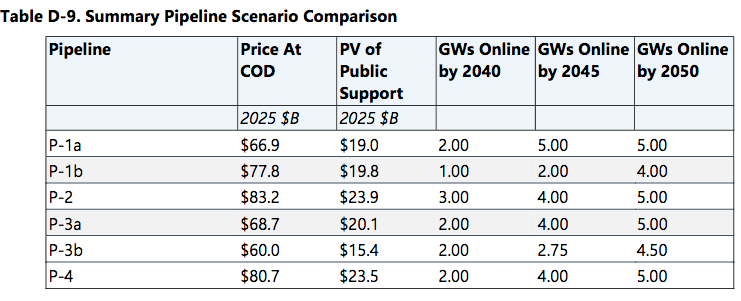
- The Paper states the base case range of costs to the State to deploy 4-5GW of advanced nuclear power are $15.4B to $23.9B in 2025 dollars for deployment at greenfield sites (costs are less at brownfield sites). Costs and benefits are discussed for numerous scenarios in 68 pages of Appendices in both Section C and Section D, which is very complicated and not accessible for the public or even advocacy groups focused on these issues.
- The most simple summary chart from Appendix D is below. It shows pipeline scenarios (different reactors and building timeframes), their cost for equity investors if sold when the reactor is constructed and reaches the operational stage (COD), the present value of the government subsidy (which provides the $15.4B-$23.9B range), and the GW generated by the reactors by a particular year:
- The Paper’s Appendix C puts forth so-called maximum learning rates that reduce costs by the applicable percentage as advanced nuclear is deployed, with learning rates reduced from the maximum based on the type of reactor deployed, whether reactors are deployed at the same location, whether the workforce has worked on said reactor, among other factors. These are assumptions that may not actually be realized to reduce costs given only 2 reactors have actually been built in the last 35 years in the United States in Georgia, which were plagued by cost overruns of $20 billion and the company building then going bankrupt.
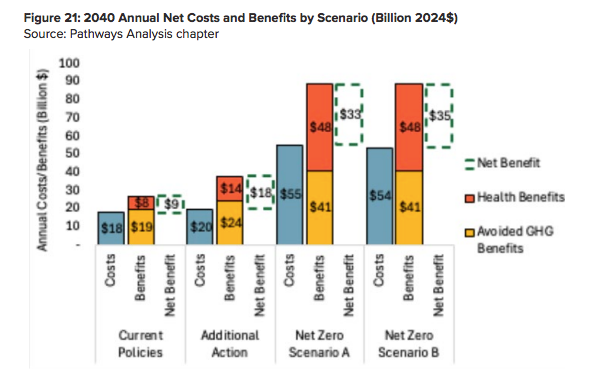
- The paper claims that while 4-5 GW of nuclear costs $15.4-$23.9B, it provides net system benefits of $28.1 billion by 2040 and $47.2 billion by 2050 (NPV) relative to a baseline without new nuclear beyond the 1GW the Governor has charged NYPA with creating, and not including operational benefits of the plants beyond 2050, as shown on the chart below on the next page: