
Fundamentally Flawed, Illogical ESD Report Massively Exaggerates Benefits to Taxpayers of NYS $800m/Year Film-TV Production Subsidies
On New Year’s Eve of last year, Empire State Development (ESD) published another “analysis” by their consultant Regional Economic Models, Inc. (REMI) claiming that New York State’s $800-million-a-year subsidy of film and TV productions is a useful way to spend tax dollars. Unfortunately, their report is fundamentally flawed – its findings are simply false and have been repeatedly debunked by experts independent of the film/TV industry and politicized economic development agencies.
ESD/REMI report fundamentally flawed, illogical
- Assumes 100% of film/TV production spending and jobs are due to state subsidy, but presents zero evidence to support that extraordinary conclusion.
- Ignores findings of comprehensive 2023 NYS-funded PFM Group report and dozens of independent experts.
1. The burden of proof is on ESD/REMI to show why it is reasonable to assume that 100% of film/TV spending and employment are the result of NY State subsidies – which underlies REMI’s projections.
Science, logic, and law are rooted in the basic principle that the burden of proof is on the party making an assertion. The great astronomer Carl Sagan famously said, “Extraordinary claims require extraordinary evidence.” This seems logical and obvious – so why then does anyone believe anything based on ESD/REMI’s assumption that every single film/TV production job exists because of the State’s $800 million a year subsidy?
ESD/REMI offers no evidence that any – let alone all – film/TV production spending or direct employment is caused by state subsidies.
Baked into the calculations done in the ESD/REMI report is the assumption that 100% of film/TV spending and jobs are the result of state subsidies. But no evidence is presented to support that extraordinary assumption. ESD and REMI do not explain the basis for the assumption, nor is there any discussion of what economists call the “but-for” argument, in which subsidy supporters claim that “but for” the subsidy, there would be no film/TV industry.
ESD/REMI’s ridiculous assumption that all investment and jobs are due to state subsidy resulted in massive exaggeration of return on investment for taxpayers.
ESD/REMI’s return on investment calculations in the last bulleted item on page 5 assume that 100% of production and post-production projects underway during 2023-2024 are the result of the state subsidy – which is extremely doubtful and not supported by any evidence.
PFM Group analysis of Bureau of Labor Statistic data suggests large portion of film/TV production jobs would occur without subsidy.
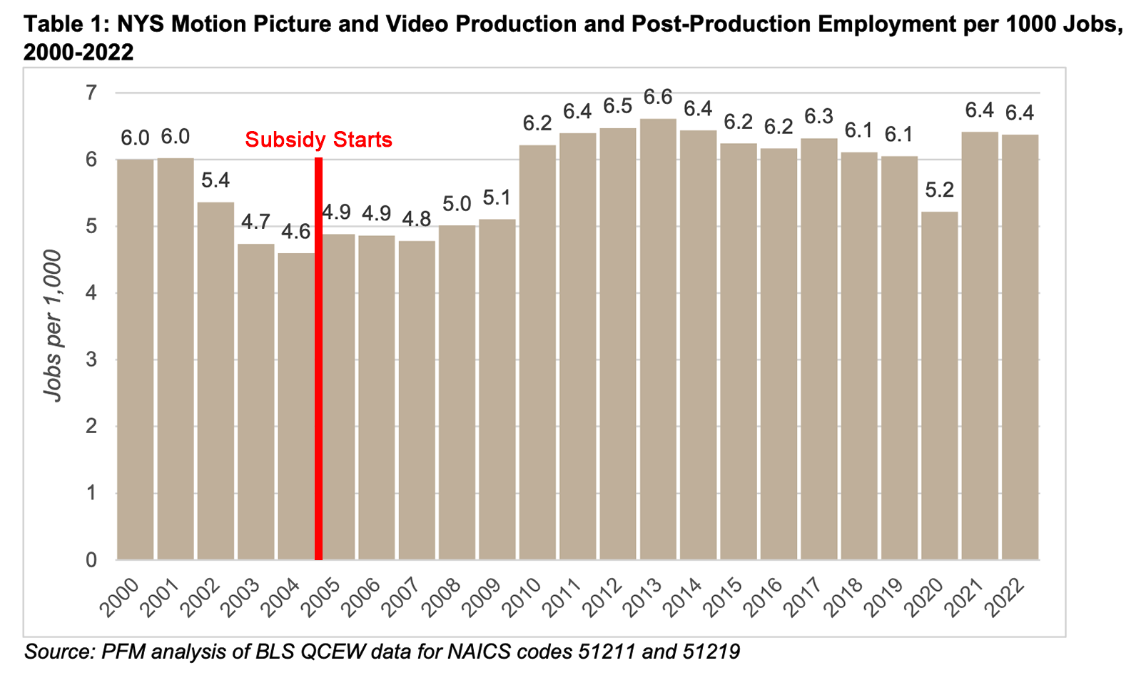
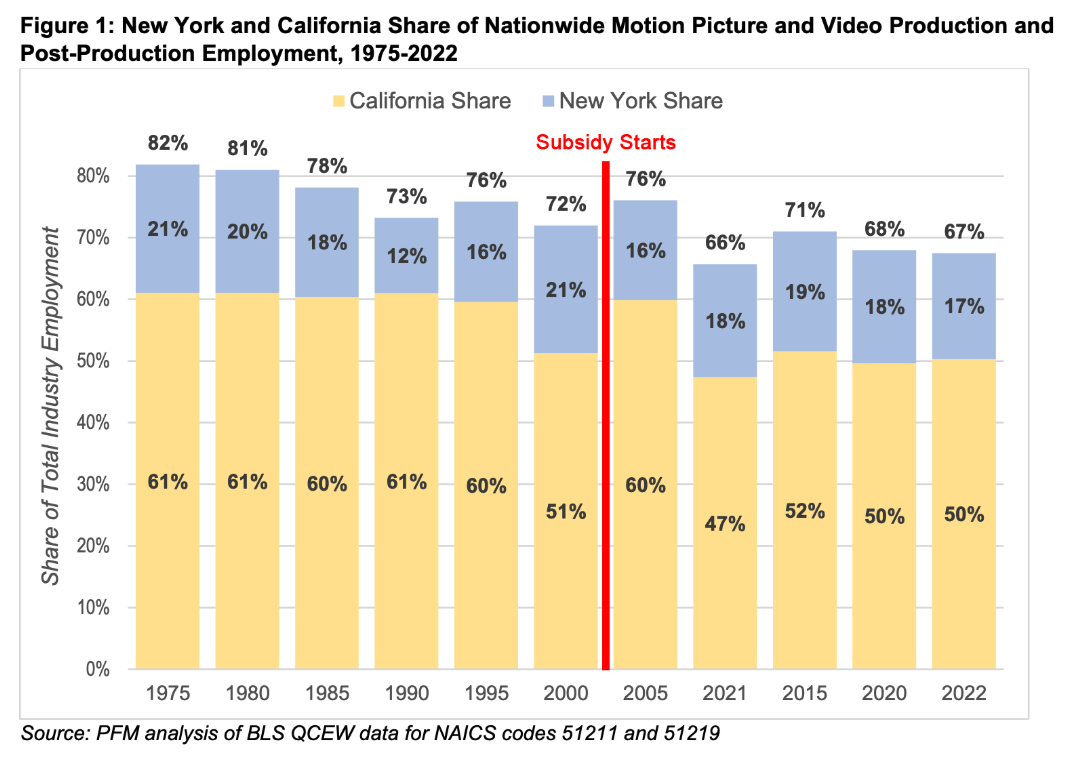
Nobody knows exactly what portion of film/TV productions take place in New York because of the state production subsidy, but it is reasonable to assume that even without the subsidy a large number of productions would still occur here. New York’s film/TV production subsidy was created in 2oo4 in theory because Canada was poaching NY film jobs. But despite a huge increase in the size of the subsidy, from 2012 to 2022, NY film/TV employment grew only 8.2%, lagging U.S. overall job growth (16%) and the national growth in film/TV production jobs (31%).
These two graphs from the PFM Group report show NYS film/production was just a bit smaller as a share of all NYS jobs and national industry jobs before the production subsidy and almost twenty years later.
2. ESD/REMI study ignores authoritative 2023 NYS-funded report by PFM group, numerous studies by independent experts.
By far the most comprehensive analysis of New York’s film/TV production tax credit is the study by the PFM Group published in late 2023, which was funded via the state budget and insulated from ESD’s interference and obvious industry bias. The PFM report was discussed at length in a legislative oversight hearing.
PFM: NYS Taxpayers Lost .69 Cents Per State $1 Spent on Film/TV Subsidy
The 2023 PFM report methodically demolished the bogus claim that the NYS film/TV subsidy is a good investment. PFM found NYS taxpayers got back only $.31 cents on every $1 spent on state film/TV subsidies. (In reality, the return to NYS taxpayers is much less than 31 cents per dollar because PFM, like ESD/REMI, assumed all film/TV jobs exist because of the state subsidy.) To their credit, on page 14, PFM group discuss what economists call the “but-for test,” which asks, “To what extent are the economic and fiscal benefits the result of the tax credit?’”
PFM and REMI Roughly Agree on Total Jobs Produced by Film/TV Spending
Both the PFM and REMI analyses assume that spending on film/TV production jobs will generate indirect and induced jobs. Reinvent Albany calculates that PFM finds that one direct job will result in 2.6 total jobs and REMI 2.7 total jobs (see page 46 of PFM report and page 6 from REMI). Where they disagree is on the additional value created by those jobs versus spending state tax dollars for a public purpose. We believe the REMI economic multiplier is grossly overexaggerated and unrealistic. More importantly, we question why ESD would have REMI produce their latest report without any attempt to address or rebut the PFM analysis – which was commissioned via the state budget and intended to be the last word in econometric analysis of the ROI of Film/TV subsidies.
ESD/REMI review of sources obviously biased in favor of film industry
Along with failing to mention the PFM report, the ESD/REMI ignores numerous studies by leading independent experts. Instead ESD/REMI serve up distortions like citing the National Conference on State Legislatures’ claim that Georgia’s film/TV subsidies produced “great returns in economic activity, state revenue, and tourism,” though Georgia’s own Department of Audits and Accounts found “economic activity generated by the film tax credit does not generate sufficient additional revenue to offset the credit, even after considering tourism and studio construction.”
Eight studies from independent experts showing why film/TV subsidies are a waste of taxpayer dollars
New York Times: Economists Call Film/TV Subsidies a Race to the Bottom
The overwhelming conclusion of independent analysts is that film/TV subsidies are a politicized boondoggle and huge waste of taxpayer funds. Policy makers should look for themselves and you can start with the eight studies below.
“Do Movie Production Incentives Generate Economic Development?” (2018)
Kennesaw State economist J.C. Bradbury: “The results indicate that neither [movie production incentives] in general, nor specific types or levels of tax credits, are associated with state economic performance.” The study, which surveyed analyses of programs across the country, found that the return on investment from state film/TV tax credits programs was negative, with the average return totaling just 27 cents per dollar spent.
USC Assistant Professor Michael Thom found that film/TV tax credits had little to no effect on wages or job creation. “We looked at job growth, wage growth, states’ share of the motion picture industry, and the industry’s output in each state. On average, the only benefits were short-term wage gains, mostly to people who already work in the industry. Job growth was almost non-existent. Market share and industry output didn’t budge,” he said.
Thom sought to determine whether film/TV tax credits programs “have contributed to employment growth.” He concluded: “Results mostly show no statistically significant effects.”
In a National Bureau of Economic Research working paper, Patrick Button found that incentives do influence film locations but that “there is no meaningful effect on feature films, and employment, wages, and establishments in the film industry and in related industries.”
“Evaluation of the Maryland Film Production Activity Tax Credit” (2015)
A report by the Maryland Department of Legislative Services found that Maryland’s film/TV tax credit program results in just 10 cents per dollar spent by the state and that “the state is actually worse off in the later years as there are fewer jobs compared to if there was no credit.”
“State Film Subsidies: Not Much Bang For Too Many Bucks” (2010)
The Center for Budget and Policy Priorities’ Robert Tannenwald found “State film subsidies are a wasteful, ineffective, and unfair instrument of economic development. While they appear to be a ‘quick fix’ that provides jobs and business to state residents with only a short lag, in reality they benefit mostly non-residents, especially well-paid non-resident film and TV professionals.”
“Motion picture production incentives and filming location decisions: a discrete choice approach” (2018)
Mark Owens and Adam Rennhoff in the Journal of Economic Geography: “We fail to find strong evidence that incentives create a more permanent movie industry in a state.”
“Policy Convergence, State Film-Production Incentives, and Employment: A Brief Case Study” (2014)
Richard Adkisson in the Journal of Economic Issues wrote “Ultimately, the evidence suggests that state efforts to attract film-production employment were largely ineffective.”