
NYS Transpo Testimony: Yes to MTA Cap, SCOUT Funding; No to MTA Debt, Special Carve-Outs
Re: Support for MTA Operating Funding, $25m for SCOUT, New MTA Capital Dashboard, Fix-It-First
Reinvent Albany advocates for transparent and accountable New York government. We are presenting our thoughts on the transportation components of the FY 27 Executive Budget, in particular related to the Metropolitan Transportation Authority (MTA).
Our testimony today focuses on the following areas:
- Support for MTA operating funding via three-year extension of business tax rates (Part E, Revenue)
- Support for $25 million expansion of MTA Subway Co-Response Outreach Teams (SCOUT) (Aid to Localities)
- Appreciation: MTA Capital Dashboard now online because of Legislature (standalone legislation, prior one-house Senate TED bills)
- MTA 2025-29 Capital Plan funding is historic, but “self-funding” shouldn’t be more debt (Capital, funded in FY 2025-2026)
- Support for MTA 2025-29 Capital Plan focused on rebuilding and state of good repair (Capital, funded in FY 2025-2026)
- No carve-outs of congestion pricing or bus camera enforcement(standalone legislation)
- Legislature is overdue to hold tax increment financing hearing (Part H, TED)
- No-fault insurance discussion should consider savings for government (Part EE, TED)
1. Support for MTA operating funding
We strongly support the Governor’s extension of the business tax rates for three years in Part E of the Revenue bill to ensure that the MTA continues to receive stable, recurring tax revenues as planned. Even better would be to not have a sunset on these funds, and for the MTA’s portion to be automatically remitted.
2. Strong support for Executive Budget’s $25 million to expand the MTA’s highly successful SCOUT program
The Governor proposes that the MTA SCOUT program expand to 15 teams, up from 10 (Aid to Localities, page 996). We strongly support expanded state investment in this innovative initiative, which teams experienced mental health professionals with specially-trained MTA police officers to help people in the subways suffering from severe mental health crises. We requested an expansion of the program along with colleagues in a public letter sent on January 8, 2026.
3. MTA Capital Dashboard now online – thank you Legislature
We thank the Legislature for its continued support for overhauling the MTA’s Capital Dashboard, which has been a component of the Senate’s one-house budget proposals for several years, and in standalone legislation, S4475 (Ramos) and A6980 (Carroll) – note these are nearly identical. In particular, we thank Senators Comrie and Ramos, and Assemblymember Carroll for their work on this issue.
It is due to the Legislature’s continued pushing and the work of advocates like Reinvent Albany that the MTA has made major improvements to its Capital Dashboard, as announced in December 2025. The new dashboard includes many of the changes the Legislature has sought, including three major improvements:
- It is powered by open data. The dashboard pulls all data directly from the open data portal, which was jumpstarted after the Legislature passed the 2021 MTA Open Data Act.
- It shows which projects are funded by congestion pricing. The public has more confidence in the MTA when they can see for themselves exactly how congestion pricing funds are being used to help get them where they are going.
- The dashboard shows the names of vendors and contract numbers for individual projects – a first. Previously, the public had to “connect the dots” for MTA capital projects using the prior dashboard, board books, and other sources for what is now all published on the dashboard.
We urge the Legislature to ensure that the dashboard keeps improving, and that it includes all active capital projects being managed by the MTA. The MTA so far is using it for all 2025-29 projects and select 2020-24 projects, with the intention to add more projects over time.
4. Support for MTA 2025-2029 Capital Plan that does not drive MTA borrowing costs above 15% of spending
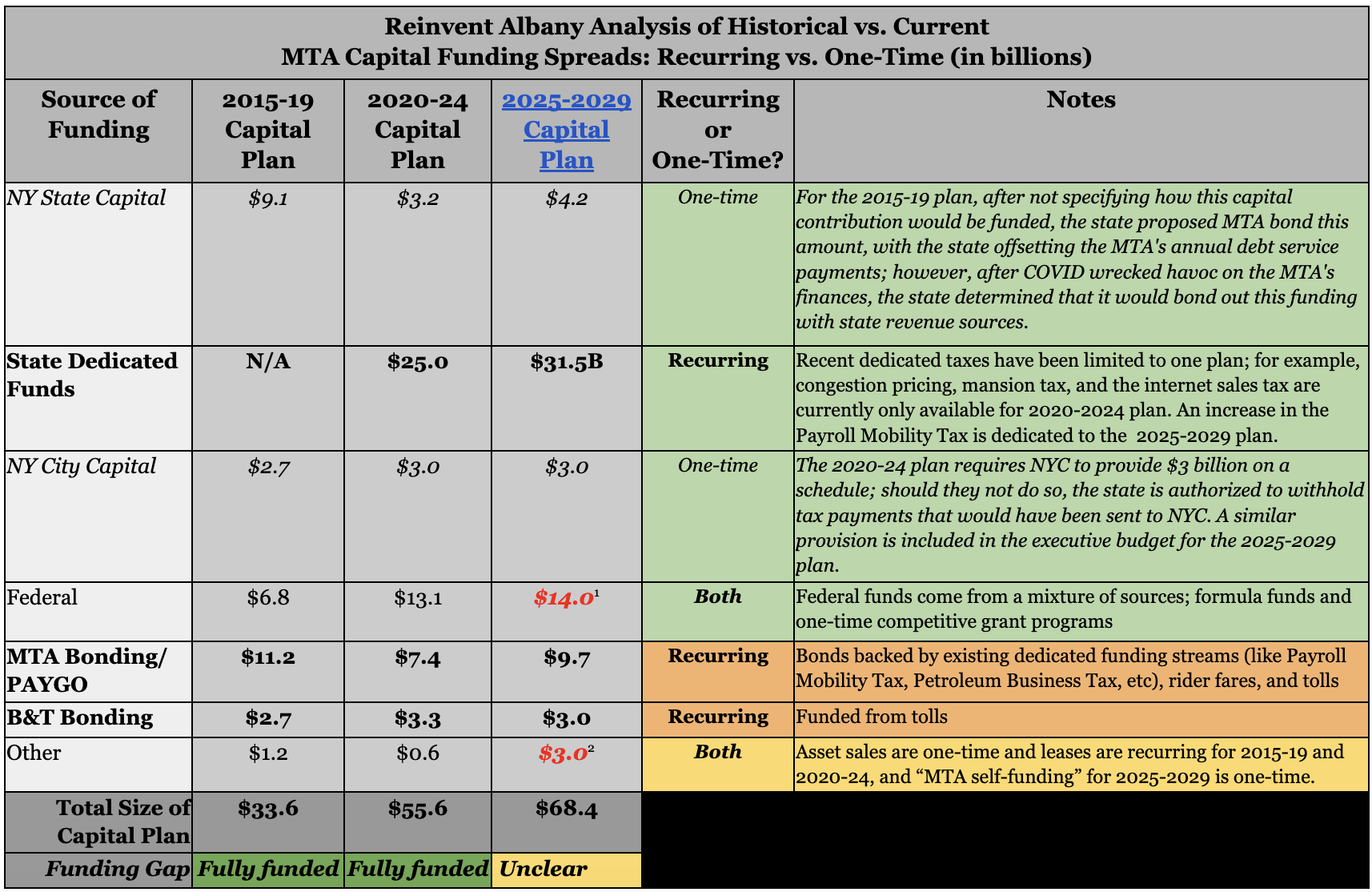
We thank the Senate and Assembly for raising the Payroll Mobility Tax last year to finance $31.5 billion of the 2025-2029 Capital Plan. We are encouraged by the Legislature’s ongoing support of the MTA and your understanding that public transit is the beating heart of the downstate economic engine, propelling regional business and revenue growth.
Unfortunately, despite your big infusion of financing, the 2025-29 Capital Plan still faces two gaping holes. First, the MTA is counting on the Trump administration to pay $14 billion of the plan. Second, even if the New York delegation can bring all the federal funds home, there is still a $3 billion shortfall the MTA is supposed to “self-fund,” possibly through efficiencies.
To us, this sounds a lot like the MTA being asked to borrow another $3 billion on top of the $48 billion in debt riders and toll-payers are already trying to pay off. We hope this is not the case and urge the Legislature to help keep the MTA from having to pay more than the 15% of its operating budget on debt payments.
5. Support for an MTA 2025-2029 Capital Plan focused on rebuilding and state of good repair
Given these potential funding gaps and that the 2025-2029 plan is 90% rebuilding and improving the system (state of good repair and improvements like modern signals), it is crucial that any funding shortfalls do not affect these essential repairs. While there is continued political interest in building expansion projects like the Second Avenue Subway extension and the Inter Borough Express, these must not come at the expense of repairs that ensure the system remains safe and reliable if there is a significant funding shortfall.
Below is our chart showing the spread of funding sources for the MTA’s last three Capital Plans, and whether they are one-time or recurring.
6. No special interest carve-outs to congestion pricing and bus camera enforcement
Reinvent Albany and more than 20 other groups strongly oppose bills seeking to exempt special interest groups from congestion pricing tolls. Results during the first year show that congestion pricing has been a success; all of these bills would result in less revenue for MTA capital projects, increased traffic congestion, and worse air quality.
Additionally, two misguided bills adding carve outs to bus lane enforcement passed last year:
- We thank Governor Hochul for vetoing S7785 (Bailey) / A8842 (Benedetto) that would have exempted Co-op City from bus lane enforcement, which we opposed.
- Another bill we opposed was signed with chapter amendments, exempting MTA workers from tickets when “providing services” to MTA vehicles or personnel (S6815 (Comrie) / A8292 (Cunningham).
We urge the Legislature to not pass any more bills this session to add carve-outs to the MTA’s successful congestion pricing or bus camera enforcement programs.
7. Legislature is overdue to hold hearing on tax increment financing hearing before extending the program again
The Legislature should hold a joint hearing on MTA tax increment financing and value capture, as it stated it intended to in the FY 2022-2023 budget, prior to extending this program again (Part H of TED). A hearing would allow the Legislature to understand potential use cases for and risks inherent to such financing schemes, and learn more from national experts about how value capture has worked elsewhere. See our blog post on TIFs about potential scholars to invite as well as our budget testimony from last year.
8. No-fault insurance restructuring should consider pedestrian and cycling safety and potential savings for government; NYC and MTA paying upwards of $170 million each a year for vehicle crashes
The Governor’s proposal on no-fault insurance (Part EE of TED) affects both average New Yorkers and government agencies. Although the overall proposal is beyond the scope of our mission, we are concerned by the central role of Uber, who we have seen repeatedly trample on local laws and regulations related to street safety and labor. We also note that New York City is the center of pedestrian, bicycle, and transit culture and has made enormous progress reducing deaths and injuries to vulnerable road users under current insurance laws.
However, we are very aware that the current insurance system imposes high costs on taxpayers, and accordingly urge the Legislature to get input from government agencies or municipalities that are frequent targets of litigation – like the MTA and the City of New York – to see if a proposal could be more narrowly targeted to help reduce costs, as documented below:
- Two-thirds of NYCT settlements involved pedestrians and motorists struck by trains and buses: The MTA reports huge overall litigation costs, but we have not seen an analysis of MTA crash claims since the Office of the State Comptroller’s 2009 report. OSC found that since 1996, NYC Transit settled 41 cases (two-thirds of all settlements) costing a total of $105 million.
- Automobile crashes is fourth biggest settlement type by pay-out for NYC: New York City’s Claims Dashboard maintained by the City Comptroller shows that in fiscal year 2025, New York City paid $170.5 million in crash claims involving city vehicles.
Notably, there is so much litigation against the MTA that a big chunk of all of their Freedom of Information Law (FOIL) requests are related to lawsuits. Law firms, largely focused on personal injury cases, made 37% of MTA FOIL requests in 2024 according to our June 2025 “Listening to FOIL” report.
Thank you for your consideration.