
Key Sources for Amtrak’s “New York Penn Station Transformation Project”
Updated October 1, 2026
Reinvent Albany is closely tracking developments regarding Amtrak’s proposed “New York Penn Transformation” project. To aid advocates, stakeholders, and journalists who are monitoring and assessing the project, we have compiled a list of resources in five categories, including:
Project Timeline
According to Amtrak’s website for the project, the project timeline is shown below:
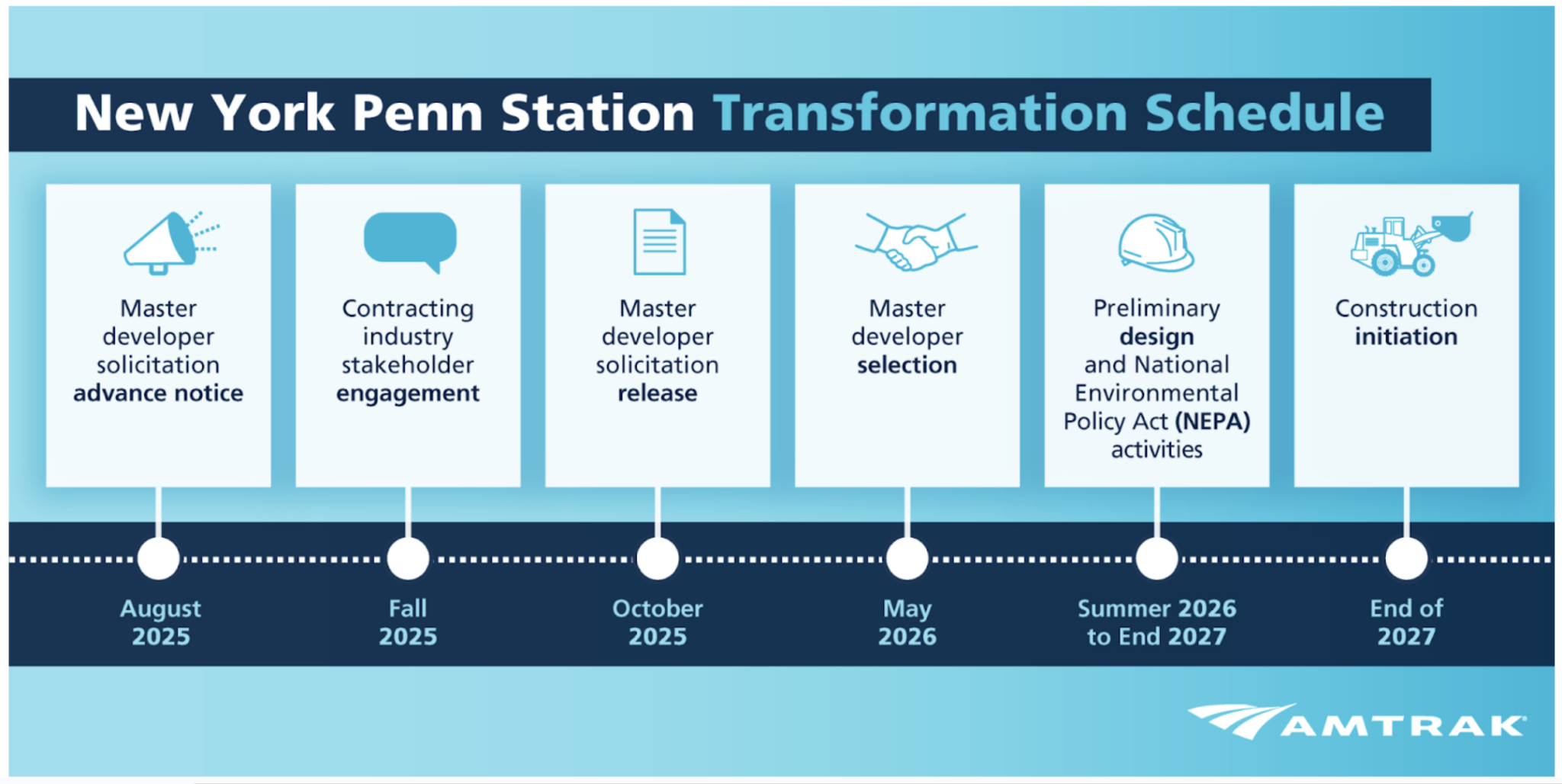
Key timelines remaining for 2026-2027 are:
- May 2026 – Master Developer Selection
- Summer 2026 to End 2027 – Preliminary Design and National Environmental Policy Act (NEPA) Review
- End of 2027 – Construction initiation
Procurement Process
Amtrak has announced the following regarding its selection of a Master Developer:
- March 2025 AECOM is selected to provide project management services
- January 2026 Notice of Shortlisted Teams – New York Penn Station Transformation Project Master Developer
- October 2025; revised December 2025 Request for Letters of Interest – New York Penn Station Transformation Project Master Developer
- August 2025 Advance Notice for the New York Penn Station Transformation Project Master Developer Solicitation
- May 2026 Master Developer Team Selected
- June 2026 Pre-Development Agreement (PDA) Signed by Amtrak and Penn Transformation Partners
Unfortunately, despite requests from Reinvent Albany and elected officials representing the Penn Station area, Amtrak declined to release the full set of documents shared through the Request for Proposals (RFP) process for the project before the master developer is selected. Amtrak has only released the “Addendum 11.2” version of the Instructions to Proposers, not prior versions or information sent to bidders. There are also concerns about what will be shared after the selection; Amtrak responded to the elected officials’ letter, stating:
“Upon conclusion of the Master Developer procurement process, Amtrak does intend to publish a summary of the procurement process, including participating teams, overviews of the proposals that proposers will have prepared for public dissemination, and the selection process followed.“
This is not a commitment to release the full contents of the RFP, its amendments, and any other information provided to the bidders.
In response to a FOIA request, Reinvent Albany received several versions of the RFP as were released to bidders, including prior amendments. However, 14,000 pages of documents were sent in 200 separate files separated by file size, not as separate, distinct documents. It also appears that a number of redactions were made; for example, we are missing Addendums 3, 4, 6, and 7, and some versions of the project agreement term sheet. We plan to appeal, and are reviewing the documents to determine what information can be gleaned about the procurement process and will provide an update in the coming weeks.
Additionally, we filed a FOIA request for the complete proposals submitted by the three shortlisted teams in response to Amtrak’s RFP, but have not yet received a response beyond an acknowledgement.
Agreements
Madison Square Garden Entertainment’s SEC filings show that it has entered into a “nonbinding memorandum of understanding” with Penn Transformation Partners that specifies that MSG will remain fully operational as required by the company, and “contemplating the transfer of the Infosys Theater at MSG to the Master Developer.”
Reinvent Albany received via a FOIL request a copy of the “collaboration agreement” that Amtak has asked the MTA to sign. See our Op-Ed as first published in the NY Daily News about why the agreement and the Penn Station project as a whole is a bad deal for New York. The agreement was also the subject of a number of letters between Amtrak and the MTA which we received in response to a separate FOIL request:
Financing
Reinvent Albany has long been concerned that the federal takeover of the project will result in New York being forced to pay for the project in some form. One particular concern was that development would be used to fund the project. Under the state’s “Empire Station Complex” Penn Station proposal pushed by former Governor Andrew Cuomo and Empire State Development, New York City tax revenues would have funded a portion of the project through Payments in Lieu of Taxes (PILOTS). (See our list of resources for the prior project, including the General Project Plan that Governor Kathy Hochul “decoupled” from Penn Station Rebuilding)
Unfortunately, our fears have been confirmed. An amendment was recently made to the BUILD America 250 Act currently being considered by the House of Representatives that gives Amtrak the ability to take over control of NYC taxation and zoning in the name of “Transit Oriented Development.” The amendment received strong local opposition, including from Congressmember Jerry Nadler, Manhattan Borough President Hoylman-Sigal, and other electeds representing the area: Senators Liz Krueger and Eric Bottcher, Assemblymembers Tony Simone and Micah Lasher, and Councilmember Craig Wilson. The electeds sent a letter to DOT Secretary Duffy expressing opposition to the amendment and concerns about the lack of transparency surrounding the procurement process.
Reinvent Albany also sent a letter on January 29, 2026 to Amtrak’s project lead for Penn Station, Andy Byford, asking for answers on a number of questions related to the project’s financing. Amtrak responded to our questions on February 10, 2026.
The specific questions and answers to our letter as provided by Amtrak are below.
- Who will pay for the Project? How much federal money is available now?
The budget for the Project’s implementation is expected to be fully developed by 2027, once design and other Project development activities are completed. Amtrak expects to seek significant funding from the federal government in the form of loans and grants, potentially including grant programs with local match requirements where Amtrak and other project partners will be expected to contribute. Amtrak also anticipates the Master Developer to fund a portion of the project. In August 2025, the United States Department of Transportation (USDOT) announced a grant of approximately $43 million from the Federal Railroad Administration (FRA) to Amtrak to procure a Master Developer and initiate preliminary Project development work. Amtrak plans to pursue additional federal grant opportunities as soon as this year.
- Why is there a private finance component when federal borrowing could spread the cost of a national infrastructure project across the national tax base?
As stated above, the Project is being executed as a progressive public-private partnership (P3). P3s are long-term contractual agreements between a public agency and a private entity to deliver an infrastructure project. By using a P3 delivery model, it allows us the opportunity to bring private sector efficiency, capital, and expertise to the project. P3s can provide public agencies and projects with access to private capital to help accelerate project delivery, allocate project risks among public and private sector entities, bring innovation to public projects, and create incentives for efficient management of public assets.
Amtrak is planning to seek significant federal funds to deliver the project and is in on-going conversations with the federal government to ensure they are aware of our funding needs at every stage of the process. It is unrealistic to think any single party will bear the entire project cost given the anticipated magnitude of the project.
- Will user fees paid by NYC-area railroads or their riders be considered?
No, Amtrak is not considering user fees.
- Do project/financing parameters contemplate commercial real estate development outside of the station and/or Amtrak’s property boundaries?
At this stage in the project, it is too early to determine if there will be any commercial real estate development outside of the station and/or Amtrak’s property boundaries as no proposals, only team qualifications, have been reviewed thus far. Amtrak outlined a base scope for the project that only included elements in the footprint of the station and the Penn Station Service Building, which is Amtrak-owned property adjacent to the station. But the process is also designed to allow for “scope enhancements,” namely, innovative ideas for improving Penn Station and/or financing the project beyond the base scope elements.
Master Developer teams must demonstrate that any scope enhancements are feasible and provide a net benefit to the project. Amtrak is not obligated to proceed with any proposed scope enhancements, even if we move forward with a Master Developer team that proposed one.
- How long are the terms of the agreement?
Once the evaluation committee has selected a preferred proposer, Amtrak will seek approval to enter a contract with the Master Developer referred to as a “pre-development agreement” or PDA. Amtrak is not committing to a final design or financial plan for the transformation of Penn Station through this procurement process; instead, this contract provides a framework for Amtrak and the Master Developer to further develop the project and strategy for implementation, including advancing design work and financial planning activities. PDA activities are expected to occur between 2026-2027.
Recent News Coverage
Reporting on the project has focused on the selection process’s lack of transparency, the inclusion of Vornado in the “Shortlisted” teams, and the effort to take control over local zoning and taxation. Relevant articles are listed below.
- 9/25/2026 – Dave Colon, StreetsBlog: Revealed! Trump’s Penn Station Contract Would Have Handcuffed MTA On Lease — And Let Duffy Say Whatever He Wants
- 7/27/2026 – Evan Simko-Bednarski, New York Daily News: Penn Station funding bill DOA in Senate if renaming it ‘Trump Station’ is in the plan: Schumer
- 7/23/2026 – Dave Colon, StreetsBlog: Wow, Who Could Sean Duffy Possibly Want To Rename Penn Station For?
- 7/23/2026 – Evan Simko-Bednarski, New York Daily News: Feds look to rename Penn Station, potentially for Trump, in transit priorities letter
- 7/21/2026 – Dave Colon, StreetsBlog: Analysis: Through-Running Tease Is The Latest Gloss On Trump’s Penn Station Shell Game
- 6/29/2026 – Dave Colon, StreetsBlog: The Explainer: Why The Penn Station Project Is Getting All Messed Up, Again
- 6/24/2026 – Ramsey Khalifeh, Gothamist: Gov. Hochul moves to de-escalate Penn Station fight between MTA and Amtrak
- 6/23/2026 – Ramsey Khalifeh, Gothamist: MTA chair calls Amtrak’s Penn Station planning ‘bizarre,’ declines to join as partner
- 6/23/2026 – Dave Colon, StreetsBlog: Press Boxed: MTA Boss Accuses Amtrak’s Byford Of ‘Gamesmanship’ With Leaked Letter About Penn Station
- 6/8/2026 – Michael Oreskes, West Side Spirit: Manhattan Electeds Escalate Attack on Trump Penn Station Plan; Byford Fires Back
- 6/7/2026 – Catalina Gonella, Gothamist: Penn Station critics demand answers on Trump-led overhaul, developer selection
- 6/7/2026 – Dean Moses, AMNY: New York politicians demand answers over Trump’s Penn Station ‘closed door’ deals
- 5/28/2026 – Ethan Stark-Miller, AMNY: Penn Station cash grab? Federal bill amendment may let Trump admin finance hub’s development with local tax dollars
- 5/27/2026 – Dave Colon, Streetsblog: Art of the Steal: Congress Sets the Stage For Trump Land Grab To Fund Penn Station
- 5/22/2026 – Evan Simko-Bednarski, New York Daily News: The feds already took control of the Penn Station project in NYC. They may be gunning for more.
- 4/23/2026 – Ramsey Khalifeh, Gothamist: How the MTA lost control of the Penn Station rebuild — and $74M in the process
- 4/21/2026 – Alyssa Paolicelli, NY1: Penn Station to get upgrade as part of $4.7B in Amtrak funding
- 3/30/2026 – Andrea Siff, NBC New York: Is Madison Square Garden really moving? Where the arena could wind up
- 3/26/2026 – Ramsey Khalifeh, Gothamist: Trump weighs moving Madison Square Garden for Penn Station rebuild, sources say
- 3/22/2026 – Haley Brown, NY Post: ‘Train Daddy’ keeps door open to private real-estate deals in Penn Station redesign — triggering NYC taxpayer warning
- 2/6/2026 – Dave Colon, Streetsblog: Andy Byford’s ‘Trump Card’ On Penn Station Keeps Wrecking New York’s Infrastructure Projects
- 2/2/2026 – Nick Garber, New York Focus: Landlord That Won Big in Cuomo’s Penn Station Plan Makes a Comeback Under Trump
- 1/29/2026 – Dave Colon, Streetsblog: Byford Hopes Cash-Strapped NYC Will Help Fund Trump’s Penn Station Rehab
- 1/22/2026 – Dave Colon, Streetsblog: Amtrak Quietly Fast-Tracking Trump Penn Station Transformation