
Statement on 2026 NYS Legislative Session and Transparency, Accountability, Corporate Subsidy Bills
Dismal NY Legislative Session Caps Season of Stagnation for Democracy, Transparency, Accountability, Subsidy Reforms
Healthy democracies hold public hearings on bills and do not propose extreme gerrymandering of state Senate and Assembly districts
New York’s democracy is stagnating under the weight of big dog special interests maximizing their gains and crushing attempts to make our state government more responsive, transparent, and accountable to the broader public. New York spends far more than most other states, yet, overall, our people are not the happiest, healthiest, wealthiest, or best educated.
New York’s Legislature passed 759 bills this year, none of which were scrutinized in a public hearing. In contrast, California, a much larger state, passes more bills every year and requires that all bills be considered at a public hearing before passage, and around 90% ultimately are. Public hearings may seem arcane, but shining a bright light on proposed legislation is immensely helpful to the public interest. For example, New York’s Senate and Assembly just voted for a resolution to amend the State Constitution to allow the extreme gerrymandering of state legislative districts. Would they have passed the resolution after a public hearing where it was assailed by concerned citizens and then editorial boards?
Here’s what happened to Reinvent Albany’s priority bills:
Open Government
FOIL
- Limit commercial FOIL exemption (S9777 (Sepúlveda) / A1410 (Rosenthal)) – Passed Assembly only.
- Report FOIL activity (S9739 (Kavanagh) / A2321 (McDonald)) – Passed Assembly only.
- Strengthen FOIL attorneys’ fees (S1418-A (Liu) / A950-A (Steck)) – Passed Senate only (the Assembly passed a weaker bill related to attorneys fees).
- Reduce agency FOIL response time (S10098 (Skoufis) / A10759 (Raga)) – Passed Senate only.
- Require electronic FOIL appeals (S9607 (May) / A11143 (Kassay)) – Did not pass either house.
Judicial Decisions
- Require the Office of Court Administration to issue a report on publication of criminal court decisions (S3864-A (Gianaris) / A4674-A (Burdick)) – Passed both houses.
Accountable Government
Ethics, Lobbying, and Financial Disclosure
- Require financial disclosure statements of candidates for office to be posted on the Commission on Ethics and Lobbying in Government website (S4857-C (Skoufis) / A463-B (Paulin)) – Passed both houses.
- Require electronic filing of all lobbying filings (S5843 (Skoufis) / A2330 (McDonald)) – Passed both houses.
- Require lobbyists to report support for or opposition to legislation (S9557-B (Mayer) / A9559 (Rajkumar)) – Passed Senate only.
- Disclose lobbying activities for confirmation or nomination of persons to state office (S374 (Gianaris) / A7456 (McDonald)) – Passed Senate only.
Corporate Subsidies
- End NY’s Opportunity Zone tax break (S3340 (Gianaris) / A3246 (Dinowitz)) – Passed Senate only.
- Add school board and labor representatives to IDA boards (S4464-A (Mayer) / A838-A (Solages)) – Passed Senate only.
- Require employers to submit a semi-annual report detailing the number of jobs going to local residents for a subsidized project (S9371 (Comrie ) / A10545 (Solages)) – Did not pass either house.
- Authorize County Comptrollers to audit IDAs and LDCs (S5563 (Mayer) / A7666 (Solages)) – Passed Senate only.
- Prohibit county IDAs from offering incentives in municipalities with their own IDA (S3159 (Skoufis) / A5258 (Solages)) – Did not pass either house.
- Prohibit data centers from receiving IDA tax breaks (S9182-A (May) / A10852-A (Kelles)) – Did not pass either house. Both houses did pass a one-year moratorium on data centers, which includes transparency provisions for subsidies that data centers receive.
- Prevent IDAs from abating school district taxes (S10269 (Skoufis) / A4297 (Bronson)) – Did not pass either house.
As also noted by NYPIRG, the 2026 legislative session was less productive than prior sessions under Governor Hochul’s term. Only 759 bills were passed by both houses, compared to a high of 1,007 in 2022. This year was also the session with the latest budget since 2016. While Reinvent Albany’s prior analysis showed that the Legislature was passing legislation at an average pace up until May 15th, their progress slowed in the last weeks of session.
Besides the late budget, one other reason for the lack of productivity could be that the State Senate considered a large number of confirmations during the last week of session. It only considered one appointee before June. As noted by the NY Daily News, the process is often rushed by the Governor, who provides names to the Senate at the last minute. The 2026 session appears to be no different than prior years; In both 2023 and 2021, the bulk of Senate confirmations occurred in June, according to Reinvent Albany’s analysis.
Late Budget Slowed Legislative Productivity – Particularly in Last Week of Session
As also noted by NYPIRG, the 2026 legislative session was less productive than prior sessions under Governor Hochul’s term. Only 759 bills were passed by both houses, compared to a high of 1,007 in 2022. This year was also the session with the latest budget since 2016. While Reinvent Albany’s prior analysis showed that the Legislature was passing legislation at an average pace up until May 15th, their progress slowed in the last weeks of session.
Besides the late budget, one other reason for the lack of productivity could be that the State Senate considered a large number of confirmations during the last week of session. It only considered one appointee before June. As noted by the NY Daily News, the process is often rushed by the Governor, who provides names to the Senate at the last minute. The 2026 session appears to be no different than prior years; In both 2023 and 2021, the bulk of Senate confirmations occurred in June, according to Reinvent Albany’s analysis.

*Assembly bills passed appear lower than the number of two-house bills passed because we used the “Assembly Bills Passed Assembly” search term in the Legislative Retrieval System. This only counts two-house bills that passed the Assembly first. When bills pass the Senate first and move to the Assembly, they are “substituted” for the corresponding Assembly bill.
**Legislature reconvened in July after ending session early in May due to the COVID-19 pandemic. No other special session activity is included.
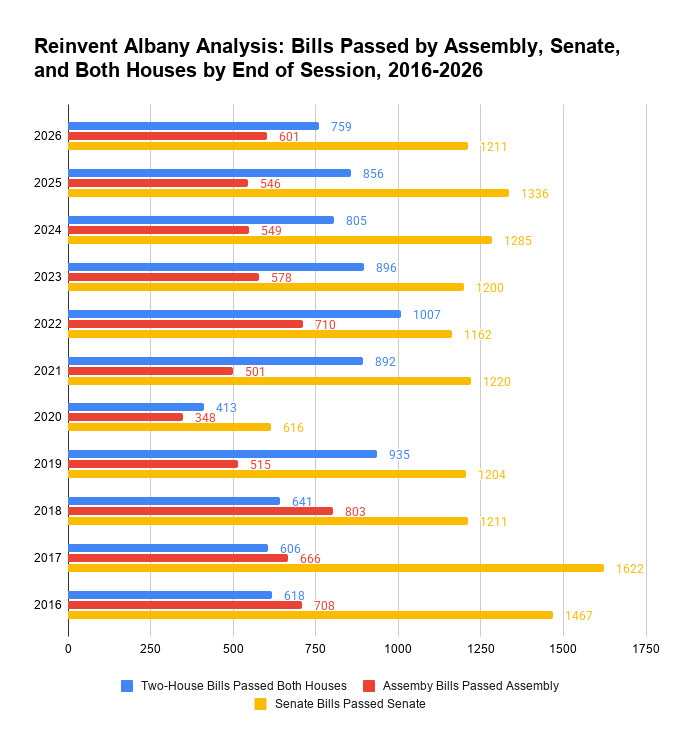
Click here to view the data of bills passed by the end of session.