
Testimony to Charter Revision Commission on NYC Ethics, Oversight
Testimony to NYC Charter Commission on Government Efficiency
Re: Strengthening Oversight Agencies like DOI and COIB Boosts Fair, Effective Government and Increases Bang for Taxpayer Buck
$1 spent on DOI saves NYC at least $18 in tax dollars
Good evening, members and staff of the Charter Commission. My name is Rachael Fauss, Senior Policy Advisor for Reinvent Albany. We advocate for transparent and accountable government in New York.
We welcomed the appointment of this Commission, and despite the short timeline, believe you will propose realistic actions to make NYC government more effective and accountable.
The last mayoral administration was rocked by the biggest series of corruption scandals in decades and revealed strengths and weaknesses in the city’s internal controls and watchdogs. We believe the Commission must respond to this eruption of corruption by taking steps to strengthen NYC’s frontline ethics agencies: the Department of Investigation (DOI) and Conflicts of Interest Board (COIB). Additionally, we support measures that would strengthen the Mayor’s Office of Contract Services (MOCS), ensuring its permanence and protecting its professional staff.
We urge the Commission to propose the following five measures to voters:
- Strengthen the Department of Investigation (DOI) and Conflicts of Interest Board (COIB) using independent budgeting and independent appointment processes, protecting DOI and COIB staff.
- Put the Mayor’s Office of Contract Services (MOCS) into the City Charter with clear roles, responsibilities, and authority per the recommendation of the Independent Budget Office to the 2025 Charter Reform Commission.
- Make ethics guidance issued by COIB far more transparent, amending Chapter 68 of the City Charter.
- Put lobbying and ethics under one roof as an independent NYC Ethics Commission.
- Strengthen ethics laws regarding city-affiliated nonprofits.
Strengthening Internal Oversight Is an Incredibly Good Investment
The charge of this Commission is to make City government work better and more efficiently for New Yorkers. Corruption wastes taxpayer dollars, rewards the worst people, and hurts the poor and vulnerable who are most dependent on the government for help. Conversely, it is a good public investment to fund oversight agencies.
If DOI is as effective as similar internal watchdogs like the federal Inspector Generals, one dollar spent on DOI saves NYC at least $18 in tax dollars, and makes it more likely agency decisions are based on public benefit. Likewise, a dollar spent on the NYC Comptroller, which is more akin to the General Accounting Office, results in $123 in savings.
In order for all oversight agencies to be most effective, they need the ability to act without fear or favor; this requires that they are protected against removal without cause, and funded via guaranteed budgets.
Fortunately for this Commission, independent budgeting and protections against removal were recently studied by the City Council’s 2025 Charter Revision Commission, which drafted proposals for several oversight bodies, including DOI and COIB.
Detailed recommendations in these areas are provided below.
Independent Budgeting for DOI, COIB
First and foremost, the Commission should adopt well-vetted, longstanding proposals to provide independent budgeting for the Department of Investigation and the Conflicts of Interest Board. Both agencies have long sought these proposals – which are strongly supported by watchdog groups – but they have yet to advance to the voters. These proposals are low-hanging fruit that will have wide support from voters.
- Department of Investigation –DOI has sought to be funded via a formula giving it approximately .07 to .08 percent of the City’s budget. The City Council’s Charter Revision Commission proposed setting COIB’s budget at .06 percent of the City’s total expense budget.
- Conflicts of Interest Board – COIB has proposed past charter revisions that would peg its budget to .004 percent the total net expense budget of the city – with a higher amount of .007 percent if it is given the authority to conduct investigations. The City Council’s Charter Revision Commission proposed setting COIB’s budget at .0035 percent of the City’s total expense budget.
We encourage this commission to not set its sights too low – the higher the percentage, the more likely it is to hold up over time, in particular as the agencies are given new responsibilities.
DOI and COIB’s Budgets from FY17 – FY27
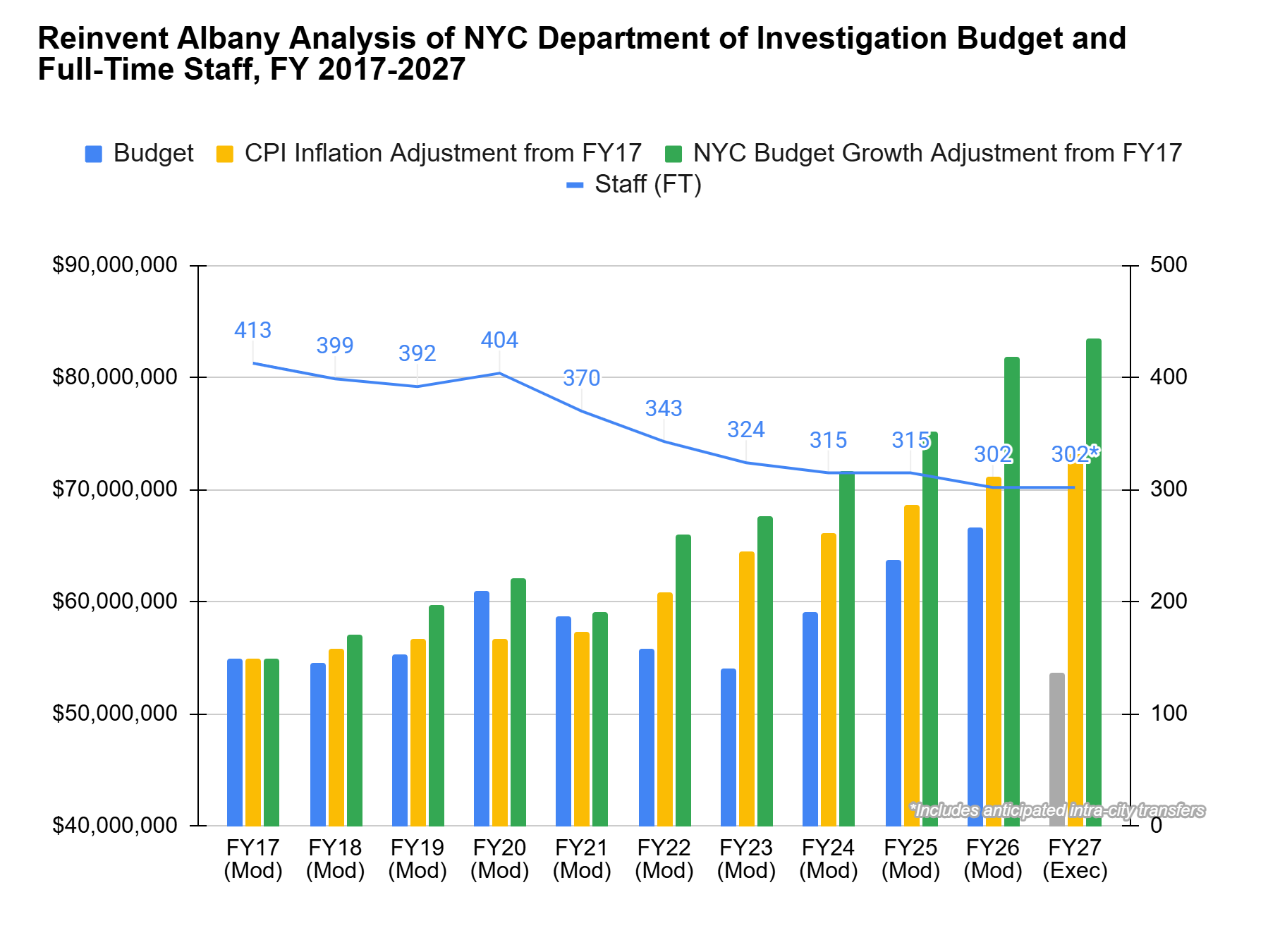
DOI in particular has been decimated by Program to Eliminate the Gap (PEG) initiatives under the Adams administration. Overall, DOI has lost more than a quarter of its baseline and intra-city funded staff – 100+ positions – since FY17. Note that 302 staff are expected for FY27 after intra-city transfers are made, though the Executive Budget funds only 282 positions that are DOI-funded. These positions are reflected in future financial plans after the transfers are made. Additionally, a number of “on-loan” positions are not reflected here that are funded directly by NYCHA, Health + Hospitals, and New York City School Construction Authority and do not show up in the city’s financial plans.
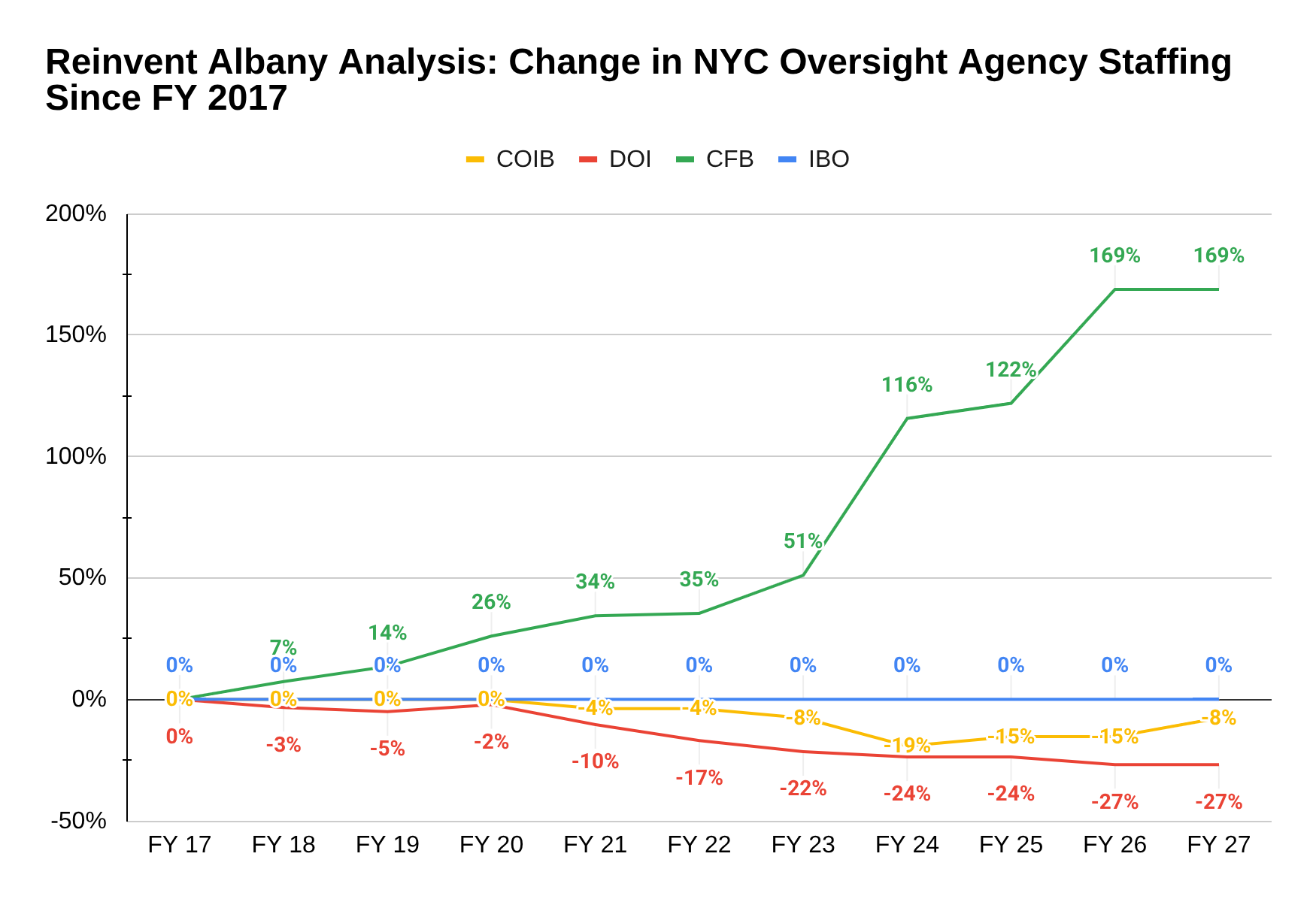
The chart below shows how DOI’s budget has failed to increase with inflation and overall increases in the NYC budget. DOI’s staff dropped 27% from FY17 to FY27, with a total loss of 111 full time employees. During this time, the NYC budget increased by nearly 52%, and the current level proposed for FY27 in the Executive Budget is 2% less than it received in FY17. A DOI budget that kept up with inflation would be $73.1 million, not $53.4 million; if it kept pace with NYC budget growth, it would be $83.4 million.
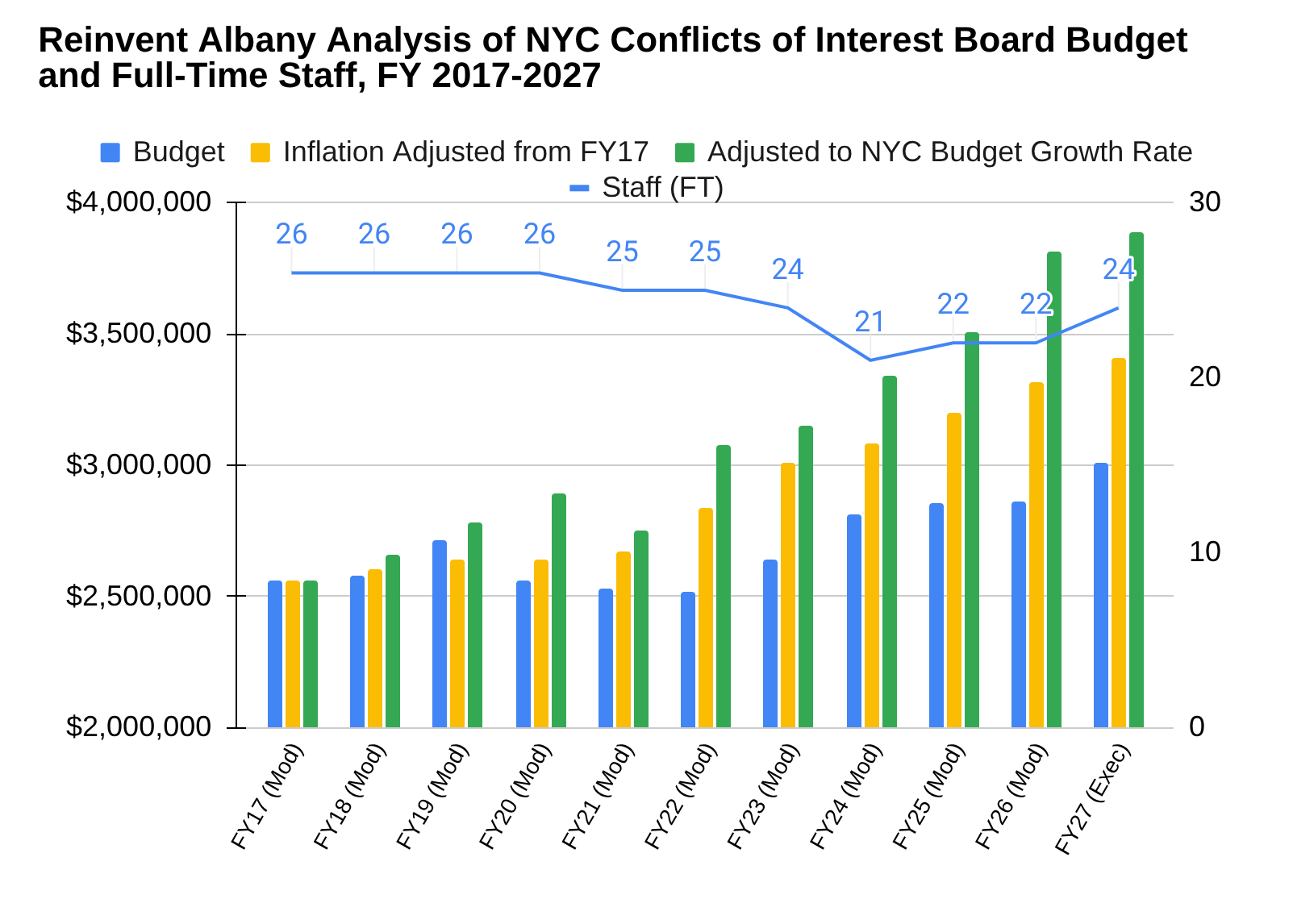
For the Conflicts of Interest Board, their budget has failed to keep pace with inflation and compensate for new responsibilities placed upon the agency – in particular, the Legal Defense Trust program that was created in 2019. While the Executive Budget provided some additional staffing, bringing the agency to 24 positions, this is still under the 26 they previously had. Additionally, as COIB testified to the City Council at their June 4, 2026 budget hearing, they have unmet IT needs like updating their archaic financial disclosure filings systems.
COIB’s staffing has dropped by 8% from FY17 to FY27, with a loss of two employees. However, as COIB stated at the budget hearing, they have not been able to maintain competitive salaries for their employees – even compared to other government positions in NYC. This is likely due to their budget failing to keep up with inflation or the increase in the size of the NYC budget.
The chart below shows the staffing reductions, and the failure of the budget to keep pace with inflation and growth of the city budget since FY17. COIB’s budget has only increased 17.5% since FY17, while the NYC budget increased 52%. A COIB budget that kept up with inflation would be $3.4 million, not $3.0 million; if it kept pace with NYC budget growth, it would be $3.9 million.
When compared to oversight agencies that have independent budgets – the Independent Budget Office and the Campaign Finance Board – it is clear that the Department of Investigation and Conflicts of Interest Board have failed to be adequately funded to fulfill their missions.
Protecting the Independence of the DOI and its Commissioner
Reinvent Albany also supports proposals advanced by DOI and accepted by the City Council’s 2025 Charter Revision Commission to protect the DOI Commissioner from removal. These include the following:
- Removal of the DOI Commissioner only for cause, with a written notice that clearly states the reasons for removal, and an opportunity for a public hearing held by the City Council.
- Giving the DOI Commissioner either a five- or seven-year year term.
- Codifying certain core DOI powers in the Charter, including that agency officers and employees of other city agencies cooperate fully with DOI investigations, and that DOI have access to those agencies’ records, data and information.
Put Lobbying and Ethics Under One Roof – Ideally Under an Independent NYC Ethics Commission
Another efficiency proposal related to ethics is putting ethics and lobbying under one roof. Currently, the Conflicts of Interest Board administers the following laws: Chapter 68 of the City Charter, the Annual Disclosure Law, Lobbyist Gift Law, Affiliated Not-for-Profits Law, and Legal Defense Trusts Law. The City Clerk’s Lobbying Bureau administers the NYC Lobbying Law. We caution that in merging these entities, there should not be staffing cuts, given that they have long been underfunded and understaffed.
Ideally, ethics and lobbying would be governed together by an independently-appointed board. The basic idea is to create an ethics agency with roughly the same responsibilities as the state’s Commission on Ethics and Lobbying in Government (COELIG), but with a more independent appointment process. Lobbying and ethics are regulated together by the state commission. There is not only logic to this arrangement given the intersecting moonlighting, post-employment, and gift laws, but it also ensures that regulators have access to information necessary to conduct enforcement actions.
With other watchdog groups and ethics experts, we helped win improvements to New York State’s ethics commission, COELIG. We successfully upheld its constitutionality before the NYS Court of Appeals – see our joint amicus brief. COELIG has a number of features that could be replicated and strengthened at the NYC level:
- Independent, balanced appointments – COELIG has three main ways in which its appointment process increases independence:
- Screening panel for nominations – The state’s law school deans approve nominations sent by the appointing authorities to ensure that candidates are qualified and will serve with independence and integrity.
- Balanced appointments – The Governor does not have a majority of appointments, but rather appoints 3 of the 11 members; the remainder are appointed by the legislative leaders, Comptroller, and Attorney General. The current Conflicts of Interest Board has a majority of mayoral appointments, with the mayor appointing 3 board members, with one each from the Comptroller and Public Advocate.
- Selection of chair by commission, not appointing authority – The chair is selected by the commission itself, and is not appointed separately by the Governor. This is a crucial mechanism to ensure that the body operates by consensus, and with independence.
Make Ethics Guidance Public by Default
We also strongly support greater transparency of written ethics guidance provided to senior officials. Ideally, all ethics guidance provided to these officials should be public by default. Currently, Chapter 68 of the NYC Charter provides that these opinions may be published, but the name of the official is redacted.
Too often, senior officials say that they received a written opinion from COIB, yet the press and public are unable to verify exactly what the guidance said, and whether the official is abiding by any limits or ground rules set by COIB.
We strongly support making all guidance to public officials public by default, and published on COIB’s website. However, other ethics agencies have provided a middle ground that provides transparency under certain circumstances:
- Waive confidentiality when an official provides misleading, inaccurate, or incomplete public disclosure regarding contents of guidance – COELIG recently adopted an advisory opinion that allows the commission to waive confidentiality and release information related to the guidance they provided.
- Require disclosure of written opinions when they are publicly cited by officials – The Charter could be amended to require that written COIB guidance be publicly disclosed when the recipient publicly acknowledges its existence.
Strengthen Ethics Laws for Donations to City-Affiliated Nonprofits, and Codify Oversight of Nonprofits in the Charter
The City has seen the growth of a shadow government in the form of city-affiliated nonprofits. While Chapter 9 of Title 3 of the New York City Administrative Code provides some rules regarding limits and disclosure of donations made to these entities, they are otherwise not subject to the more robust oversight requirements of city agencies.
As we recommended to the 2018 City Charter Revision Commission, we urge this Commission to look at the following changes:
- City-affiliated nonprofits should be codified in the charter. A new section of the city charter on city-affiliated profits should:
- Provide a listing of all city-affiliated nonprofits and their associated city agency.
- Create procedures for creating, dissolving and providing Council oversight of city-affiliated nonprofits. We believe the Council should have to approve the creation of a city-affiliated nonprofit following a public hearing and a statement by the agency as to why the nonprofit is needed. This is similar to how public authority subsidiaries are regulated at the state level.
- Explicitly require city-affiliated nonprofits to follow the Freedom of Information Law (FOIL), Open Meetings Law, and NYC Open Data Law.
- Mandate city-affiliated nonprofits follow procurement procedures of city agencies with rare exceptions.
- Report revenues and expenditures to the public, City Council and City Comptroller.
- Lay out ethics requirements for board members, staff, and fundraising.
- Limit all contributions from those doing business with the city to nonprofits affiliated with elected officials. Under Local Law 181 of 2016, donations are limited to $400 to these entities, but only if the nonprofits spends 10 percent or more of their annual budget on public-facing communications featuring the elected official, limiting its application typically to the Mayor’s Fund to Advance NYC. COIB has issued rules in this regard under Title 53 Chapter 3-03. Specifically:
- Donations to these nonprofits should always be limited from those doing business with the city – whether or not the communications of the affiliated nonprofit feature the elected official.
- Donations should be limited until 180 days after a donor has ceased doing business with the city and is removed from the doing business database.
- Restrict all donations to city government from those who do business with it. Local Law 181 of 2016 only limits contributions to nonprofits affiliated with elected officials. It doesn’t restrict donors doing business with the city from making contributions directly to government agencies. A donor can give unlimited sums to an agency even while bidding on a contract or seeking a favorable determination on a matter before the agency, provided agency officials didn’t directly solicit it and there is a disclaimer that it won’t affect their business before the city.
- Require “volunteers” doing major policy work or senior level appointments for the city to follow city ethics laws regarding fundraising. The City has, in some instances, utilized people who are not on the city payroll to do policy work or assist in choosing senior officials while they are also fundraising for nonprofits affiliated with elected officials. We do not oppose per diem or unpaid volunteers serving on city boards, task forces and commissions, much like the members of this commission. But they should not also be fundraising simultaneously for nonprofits affiliated with elected officials. If they do, they should follow city ethics laws in some form.